
JoyClik Wellbeing BlogSleep & Bedtime ArticlesSleep Tracking & Bedtime Pressure
When Sleep Becomes a Test: Sleep Tracking and the Pressure to Sleep Well
When sleep scores start shaping your day, bedtime can feel like a test. Explore five gentle ways to ease tracking pressure, use information thoughtfully and recognise when more support may help.
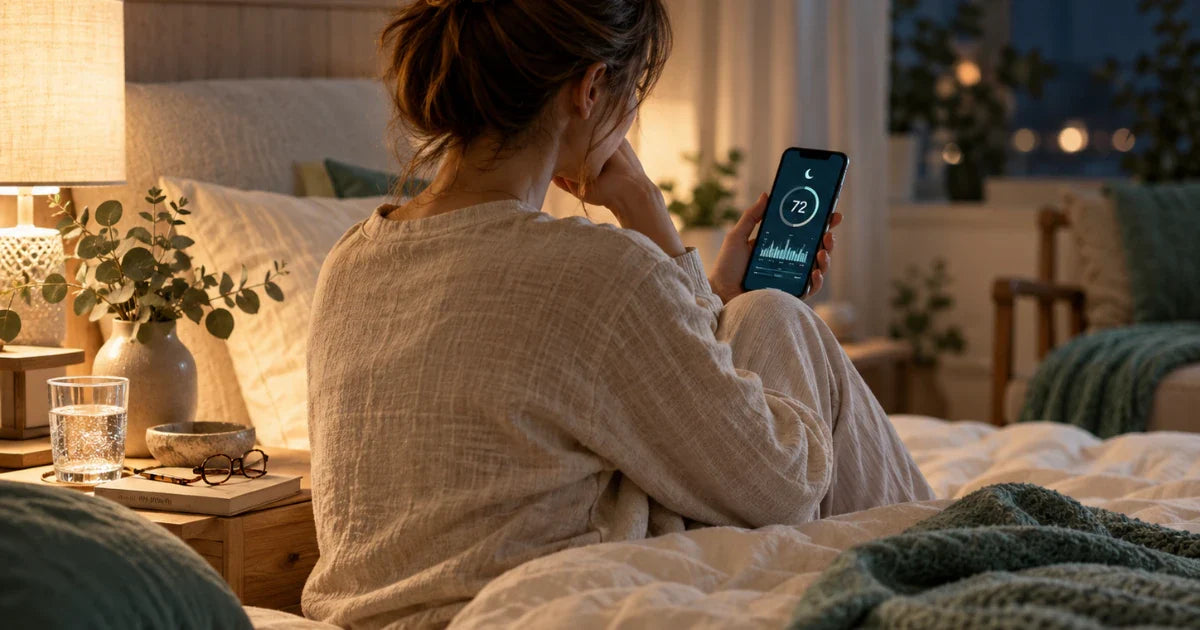
Sleep tracking can offer useful information, but it may become unhelpful when checking your results leaves you more worried, changes how you judge your day or makes bedtime feel like something you must get right. A useful starting point is to ask what decision the information helps you make. You can simplify optional tracking while still taking persistent sleep difficulties seriously.
You wake and, for a moment, feel reasonably comfortable. Then you check your sleep score.
It is lower than you expected. You look at the graph, compare it with yesterday and wonder how you will get through the day. By evening, you are already hoping tonight’s result will be better.
Or perhaps you do not wear a tracker. Your calculations happen in your head: if you fall asleep now, you can still get enough hours. A little later, you calculate again.
Both experiences can make bedtime feel like a test whose result matters before the night has even begun. When that happens, another tip or more detailed graph may not be the most useful next step.
When useful information becomes another demand
There are good reasons to pay attention to sleep. You may want to understand an irregular schedule, notice what changes around night waking or bring clearer information to a healthcare appointment.
The difficulty can begin when the question changes from “What can I learn?” to “How do I make sure tonight is good enough?”
Consider someone who sees an unexpectedly low score. They spend the day searching for an explanation, add several new bedtime rules and keep checking whether they feel sleepy. If the next score is also disappointing, they add more rules.
This is an illustrative example, not a description of everyone who tracks sleep. It shows how an attempt to gain reassurance can become a series of demands.
You might recognise a quieter version: feeling unsettled when you cannot wear your device, worrying that a missed routine has ruined the night, or treating every waking as evidence that something went wrong.
The question is whether the information is helping you respond to your needs - or taking up more attention without giving you a useful next step.
What sleep scores can and cannot tell you
Consumer sleep technology has potential benefits as well as limitations. The National Sleep Foundation’s 2026 position statement recognises opportunities for sleep measurement and personalised insights, while emphasising the importance of understanding those limits. [1]
A nightly score is a device’s summary of selected information. It is not a complete assessment of your health, your capacity for the day or how well you have cared for yourself.
Different devices and features have different evidence behind them. A wellness score should not be treated as a diagnosis or used to rule out a sleep disorder. The American Academy of Sleep Medicine has emphasised that consumer sleep information needs appropriate interpretation and does not replace a clinical evaluation. [2]
This leaves room for both your experience and the information. You can notice that you feel tired, discuss a recurring concern and still avoid treating one number as a verdict.
What about orthosomnia?
Researchers introduced the term “orthosomnia” in a 2017 report describing three people who had become preoccupied with improving their wearable sleep data. It was a small clinical case series, not evidence that trackers generally cause insomnia. [3]
Research is still developing how this experience is defined and measured, including a 2025 study developing the Bergen Orthosomnia Scale. You do not need to adopt a label to notice that checking is making you more anxious. [4]
For everyday use, the more helpful question may be: “What happens to me after I look?”
Is tracking helping you understand or adding pressure?
The distinction is often in what you do with the information. The same tool may be helpful at one time and less helpful at another.
| Tracking that supports understanding | Tracking that may be adding pressure |
|---|---|
| You have a specific question you want to explore. | You keep checking without knowing what you need to learn. |
| You consider patterns alongside how you feel and function. | One score decides how you judge the whole night or day. |
| You make a manageable change when there is a reason to. | You change several things after every disappointing result. |
| You can leave the information alone once you have reviewed it. | You repeatedly reopen the app or seek reassurance about the result. |
| Your routine can flex around ordinary life. | A missed step feels as though it has spoiled your chance of sleeping. |
These are reflection prompts, not a diagnostic checklist. You do not need to count how many apply.
You might simply notice one pattern worth changing. For example: “I open the app three times before breakfast, but the second and third checks do not help me decide anything.”
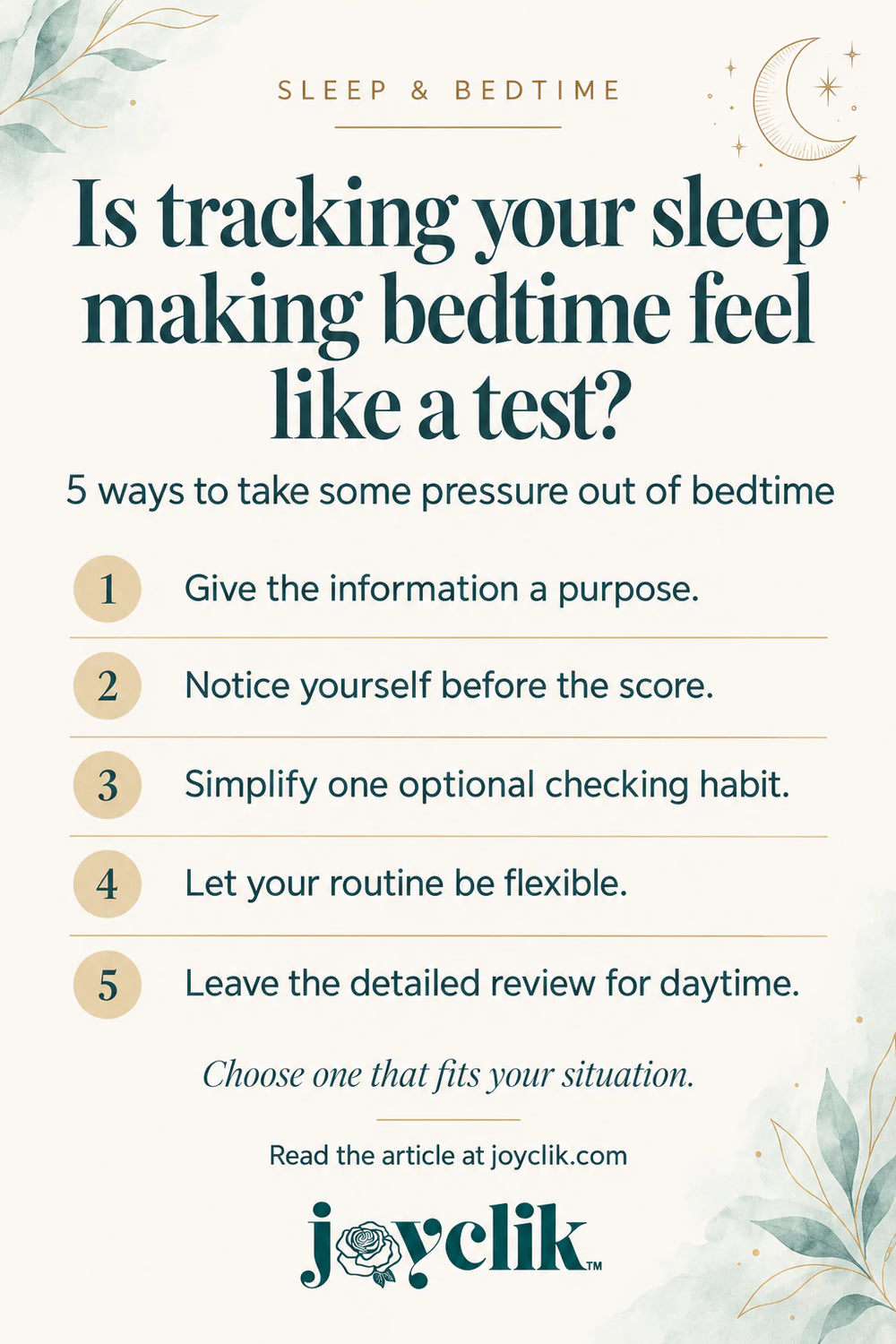
Five ways to take some pressure out of bedtime
Choose the suggestion that fits what you have noticed. There is no need to turn this into another five-part routine.
1. Give the information a purpose
Before opening the app or adding another detail to a journal, ask: “What question am I trying to answer?”
“My schedule changes each week; I want to understand that pattern” gives the information a job. “I need proof that I slept well” may leave you looking for reassurance that a score cannot reliably provide.
If you are collecting information for a healthcare professional, ask what details they need and for how long. A sleep diary can be a useful part of assessment; it is different from repeatedly checking optional scores throughout the day. [5]
If you cannot identify a useful question, consider whether you need to check right now.
2. Make room for your own experience before the score
If you usually reach straight for your results, try allowing a brief moment to notice yourself first. Do you feel sleepy, reasonably alert, uncomfortable or simply not ready to judge yet?
There is no need to rate, record or test the answer. The purpose is to give your experience a place alongside the device’s report.
If you feel reasonably well but see a low score, you might say: “This is one piece of information. I can notice how today actually unfolds.”
If you feel very sleepy despite a reassuring score, take that experience seriously. A number is not a reason to dismiss symptoms or push through an activity that feels unsafe.
3. Simplify one optional checking habit
Choose a small change to how you use the information. You might turn off a non-essential score notification, stop reopening a result you have already reviewed, or take a break from checking the wellness score if that feels appropriate.
Keep the question practical: “Does this give me more space in my day?” You do not need to measure whether you are now worrying the correct amount.
This suggestion concerns optional wellness tracking. If a clinician has asked you to keep a sleep diary or use monitoring, discuss any worry it creates and ask how to make the process manageable. Do not stop prescribed monitoring or treatment on the basis of this article.
4. Let your evening routine have some flexibility
A bedtime routine can support a transition out of the day. It becomes harder to live with when every step feels necessary for sleep to happen.
Ask which parts feel supportive and which you are completing mainly because you fear leaving them out. Perhaps quiet reading helps you wind down, while adding another relaxation exercise feels like more work.
You might keep the reading and allow the rest to be simpler. An interrupted evening does not have to become a judgement about your ability to care for yourself.
For practical foundations, explore Building a Bedtime Routine That Works. Use it to shape an evening that fits your circumstances, with room for ordinary interruptions.
5. Leave the detailed review for daytime
If bedtime has become the time you investigate every possible reason for poor sleep, consider setting the investigation aside until you are up for the day.
You could make one brief note: “Tomorrow I want to ask about the waking,” then leave it there. You do not need to solve the whole pattern in bed or record every waking in real time unless your clinician has specifically asked you to.
A useful question for later is: “Is there something practical to change or ask about?” That might lead to a conversation about shift work, pain, night sweats or worries that need attention outside the bedroom.
Sometimes the most helpful action is getting support for what is disrupting sleep, rather than refining the routine again.
A counsellor’s perspective on needing reassurance
It is understandable to want certainty when you are tired and tomorrow asks a lot of you. A number can feel reassuring because it appears to give a clear answer.
But ask what you are hoping the answer will settle. Are you worried about coping at work? Being patient with your children? Whether something is wrong?
Those concerns deserve a response of their own. You might need help with a demanding morning, a conversation about responsibilities or an appointment to discuss persistent symptoms.
For example, “I need a better score before I can manage tomorrow” could become: “Tomorrow looks demanding. What support or adjustment is available?”
That does not make tiredness disappear. It gives you a practical question you can act on without first having to produce a particular night of sleep.
A practical next step for your sleep routine
If you would like help bringing the wider picture together, the Restorative Sleep Guide offers sleep education, wind-down tools and dedicated fillable personal reset-plan pages.
Use it to explore what may be contributing to restless nights and choose an approach that fits your life. You can return to the relevant sections when you need them, rather than trying every suggestion at once.
Explore the Restorative Sleep Guide.
It is an educational digital resource, not a treatment for insomnia or a substitute for a sleep assessment.
Can a sleep journal become another test too?
Yes. The pressure can attach to a paper page as easily as an app if you feel obliged to record everything, maintain a perfect streak or find an explanation for every unsettled night.
If you use the Sleep Reset Journal or another reflective journal, consider whether the way you use it feels useful. A brief reflection may suit you; on another day, leaving it alone may be more appropriate. A personal wellbeing journal serves a different purpose from a clinical sleep diary, which should be completed as agreed with your healthcare professional.
You do not need to replace every piece of data with a written entry. The aim is to have information and support you can use.
When to seek more support
Speak with a healthcare professional if sleep difficulties persist or affect your daily life. Mention symptoms such as loud snoring with breathing pauses or gasping, significant daytime sleepiness, pain or repeated night sweats, rather than relying on a wellness score to explain them. Sleep assessment considers your symptoms, health and circumstances. [5]
For ongoing insomnia, ask about cognitive behavioural therapy for insomnia, or CBT-I. It is usually recommended as the first treatment for long-term insomnia and addresses patterns of thinking and behaviour that can maintain sleep difficulties. It is more specific than a list of sleep-hygiene tips. [6]
You do not have to prove that you have tried hard enough before asking for help. If sleepiness makes driving or operating machinery unsafe, do not rely on a reassuring score to continue.
Practical takeaways
- Give tracking a purpose: know what question the information helps you answer.
- Consider patterns and your lived experience alongside a device’s results.
- Simplify one optional checking habit if it is adding worry.
- Allow your evening routine to be supportive and flexible.
- Seek help for persistent difficulties; more data is not always the next step.
A gentle responsible-use note: This article offers general educational information and does not replace personalised medical advice, sleep assessment or treatment. Discuss changes to clinician-recommended monitoring or care with your healthcare professional. Please read JoyClik’s Professional & Medical Disclaimer.
Frequently asked questions
Should I stop using my sleep tracker?
Not necessarily. Consider whether it helps you understand a pattern or make a useful decision. If optional checking adds worry, you can simplify how you use it. Discuss changes to any clinician-recommended monitoring with the professional overseeing your care.
Is a poor sleep score a reason to assume I will have a bad day?
A score alone cannot tell you how your whole day will unfold. Notice how you actually feel and function, while taking significant tiredness or persistent symptoms seriously. You do not need to dismiss either your experience or a recurring concern.
Is orthosomnia a diagnosis I should give myself?
No. It is a term used in an evolving area of research about preoccupation with ideal sleep, often involving tracking. Recognising a pattern of worry can be useful without assigning yourself a label. A professional can help assess ongoing distress or sleep difficulty. [3], [4]
What is the difference between a sleep diary and a sleep score?
A clinical sleep diary records information requested for assessment or treatment, such as sleep timing and relevant habits. A consumer sleep score is a device’s summary. They have different purposes and should not be assumed to be interchangeable. Follow your clinician’s guidance when using a diary as part of care. [2], [5]
Keep exploring the Sleep Improvement pathway
Topic: Sleep Tracking & Bedtime Pressure
- Sleep & Bedtime Articles - focused perspectives on everyday sleep questions.
- Sleep Improvement Guide - explore the wider foundations of rest and sleep support.
- Building a Bedtime Routine That Works - choose an evening rhythm that fits your circumstances.
- Perimenopause and Sleep - consider changing sleep in midlife and when more specific support may help.
- Wellness Knowledge Hub - explore JoyClik’s four wellbeing areas.
References and further reading
- Dzierzewski, J. M., et al. (2026). Consumer sleep technology: A position statement from the National Sleep Foundation. Sleep Health, 12(2), 380–385. Read the position statement abstract.
- Khosla, S., et al. (2018). Consumer Sleep Technology: An American Academy of Sleep Medicine Position Statement. Journal of Clinical Sleep Medicine, 14(5), 877–880. Read the position statement.
- Baron, K. G., et al. (2017). Orthosomnia: Are Some Patients Taking the Quantified Self Too Far? Journal of Clinical Sleep Medicine, 13(2), 351–354. Read the case series.
- Guldbrandsen, B. V., et al. (2025). Development of a scale for measuring orthosomnia: the Bergen Orthosomnia Scale (BOS). Frontiers in Sleep. Read the research.
- National Heart, Lung, and Blood Institute. Insomnia: Diagnosis. Read the guidance.
- National Heart, Lung, and Blood Institute. Insomnia: Treatment. Read the guidance.


Sleep & Bedtime ArticlesPerimenopause, Night Waking & Restorative Sleep