
JoyClik Wellbeing BlogMindful Parenting ArticlesBig Feelings & Emotional Regulation
How to Stay Calm When Your Child Is Having a Meltdown: 7 Things to Do Instead of Yelling
When your child’s emotions explode, staying calm can feel almost impossible. Learn seven practical ways to respond with steadiness, connection and clear boundaries.

When your child is having a meltdown or another intense emotional reaction, begin by steadying your own response rather than trying to reason the feeling away. Keep your words brief, acknowledge the emotion, hold any necessary safety boundary and allow time for the intensity to come down. The teaching conversation belongs afterwards, when both of you have more capacity to take part in it.
There are moments in parenting when the crying, shouting, arguing or refusal seems to press every button you have. You ask once, then again. Your child becomes louder. You become louder. Before long, the situation is no longer about the thing that started it.
If you have ever wondered, “How am I supposed to stay calm when my child is completely losing it?”, begin by taking one pressure away: calm parenting does not mean never feeling frustrated. It does not mean finding perfect words, and it does not mean allowing unsafe or hurtful behaviour.
It means practising a small pause between what your child does and how you respond. That pause will not make every difficult moment disappear, but it can change what happens next.
Why your child’s big emotions can trigger your own
A child’s distress can activate a parent’s stress response surprisingly quickly. Your child may be screaming because screen time has ended, refusing to get dressed, fighting with a sibling, melting down after school or struggling with a transition. Meanwhile, you may already be tired, overstimulated, rushed or carrying a mental list of everything else that needs attention.
The interaction can gather speed:
Child becomes overwhelmed → parent becomes activated → parent reacts → child becomes more distressed → everyone escalates.
This does not mean you are a bad parent. It means your emotional state has become part of the environment your child is experiencing. Noticing that is not about blaming yourself; it gives you somewhere practical to intervene.
For help recognising the experiences that make you more likely to react, explore Parenting Triggers and Emotional Regulation. You do not need to remove every trigger before responding differently. The first aim is simply to notice your activation a little earlier.
Tantrum or meltdown: what may be happening?
The words tantrum and meltdown are often used as though they mean exactly the same thing, but they can describe different experiences.
A tantrum can involve intense protest, frustration or anger, particularly when a child wants something that is not happening. A meltdown more often describes becoming so overwhelmed that behavioural control is temporarily lost. Raising Children Network uses the term particularly in relation to autistic children and teenagers who become completely overwhelmed; responses may include crying, yelling, hitting, rocking, withdrawing or running away.2
You do not need to choose a perfect label in the middle of a difficult moment. A more useful question is:
Is my child able to take in guidance right now, or do they first need less stimulation, more safety and time to settle?
When emotional intensity is very high, long explanations and repeated questions are unlikely to be your most effective tools. American Academy of Pediatrics guidance for screen-time tantrums recommends that parents keep their cool, avoid lecturing and hold the limit with as few words as possible.1
Children differ in what helps. Some want closeness; others need more physical space. Some find talking helpful; others cannot process language well at the peak of distress. Avoid forcing eye contact, touch or conversation. Stay attentive to safety, your child’s cues and what you know about their sensory and communication needs.
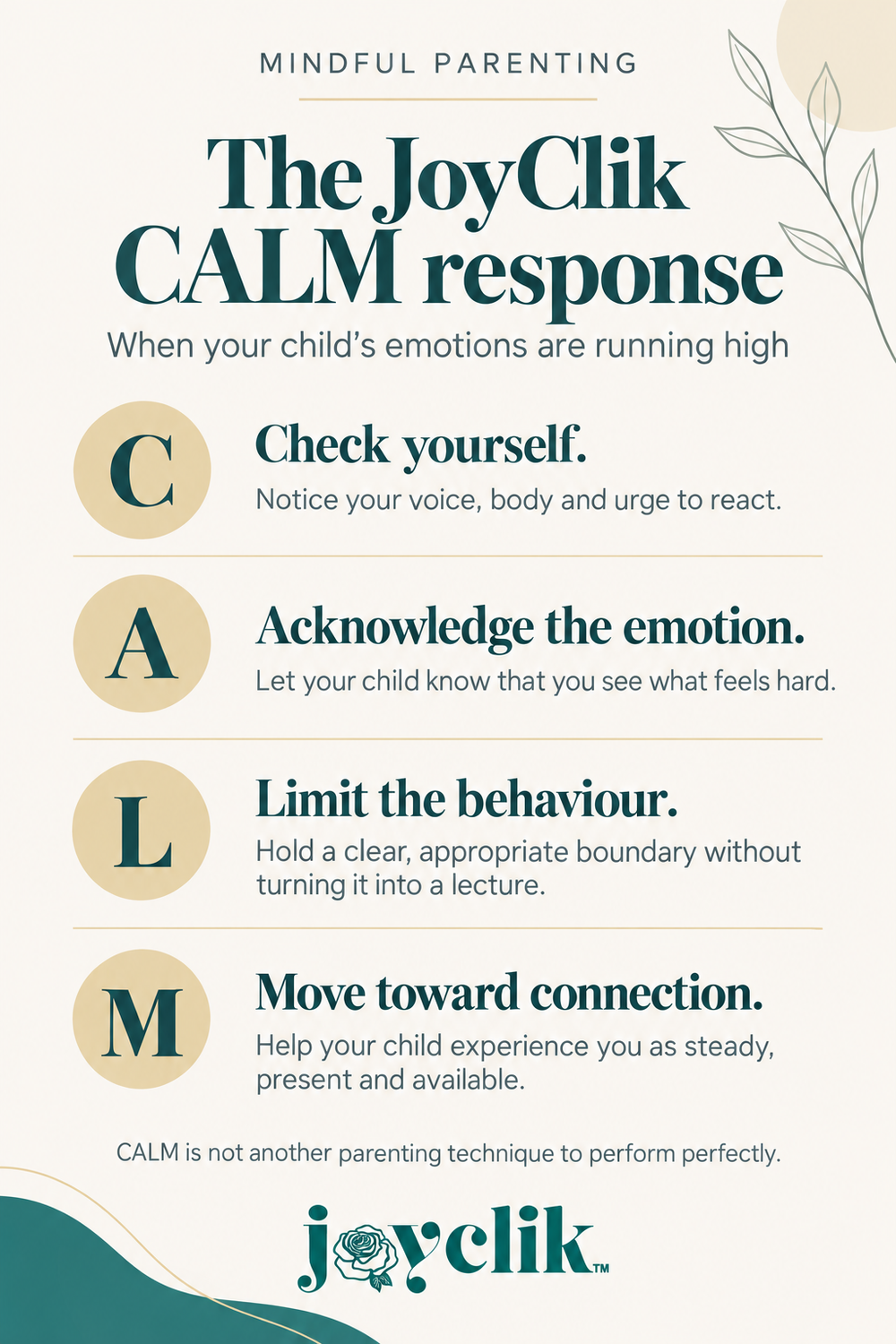
The JoyClik CALM response
When your child’s emotions are running high, use CALM as a short mental map:
C - Check yourself. Notice your voice, body and urge to react.
A - Acknowledge the emotion. Let your child know that you see what feels hard.
L - Limit the behaviour. Hold a clear, appropriate boundary without turning it into a lecture.
M - Move toward connection. Help your child experience you as steady, present and available.
CALM is not another parenting technique to perform perfectly. It is a way to remember the sequence when your own mind is under pressure: steady yourself, connect with the feeling, protect the boundary, then stay in the relationship.
Seven things to do instead of yelling
1. Check yourself before you correct your child
Before you respond, notice what is happening inside you. You may be thinking, “I cannot do this again”, “Why won’t they just listen?” or “We are already late”. Those thoughts are understandable, but they are also useful signals that your own capacity is narrowing.
Try a very small pause:
- Stop speaking for a moment.
- Let one breath out slowly without forcing it.
- Lower your shoulders and unclench your jaw.
- Deliberately soften the volume of your voice.
Then ask, “What response is most likely to help this moment rather than add more heat to it?”
You cannot control how quickly another person becomes calm. You can influence the tone, pace and amount of stimulation you add. Sometimes you do not need a ten-minute mindfulness practice; you need ten seconds before the next sentence.
2. Acknowledge the feeling without giving in
Parents sometimes worry that validating an emotion will reward difficult behaviour. Acknowledging a feeling is not the same as agreeing with everything your child wants.
You can communicate both:
- “You are really angry that screen time is finished.”
- “You wanted to keep playing. The answer is still no.”
- “You are disappointed. I can see that.”
- “Something about this feels very hard right now.”
The message is not, “You can have whatever you want.” It is, “Your feeling makes sense to me, and I am still here.”
This is central to Emotion Coaching for Parents: noticing and naming emotion while keeping the guidance and boundaries a child still needs. Raising Children Network similarly recommends identifying and naming the emotion, pausing, supporting the child while they calm, and addressing the issue afterwards.3
3. Limit the behaviour clearly
Empathy does not remove boundaries. Children need to learn that feelings are allowed while some behaviours are not.
Use a short statement that combines recognition with a limit:
- “It is okay to be angry. I won’t let you hit.”
- “You can be upset. I am moving your brother back to keep him safe.”
- “I know you want more. Screen time is finished.”
- “You do not have to like the answer. The answer is still no.”
These statements are brief. They do not require your child to agree, and they do not turn the boundary into a debate. If you need to act for safety, do so calmly and use the least intervention appropriate to the situation.
Warmth and firmness can exist together. Your child can feel deeply understood while you continue to hold a necessary limit.
4. Move toward connection
When a child is overwhelmed, it is easy to focus entirely on stopping the behaviour. Underneath that behaviour is still a child having an emotional experience.
After checking yourself, acknowledging the feeling and holding the boundary, ask: “How can I help my child feel safe, seen and supported while this feeling passes?”
Connection does not mean fixing the feeling, giving in or removing the limit. It may mean:
- staying nearby without adding more words;
- using a steady voice and relaxed posture;
- offering comfort if your child wants it;
- saying, “I’m here when you’re ready”;
- protecting other people while remaining emotionally available.
Responsive, back-and-forth relationships with caring adults are an important part of children’s developmental environment.4 The aim is not to prevent every hard emotion. It is to let difficult emotions happen within a relationship that remains as safe and connected as possible.
For a fuller exploration of that relationship, see Parent-Child Emotional Connection.
5. Give your child room to come down
Not every child wants a hug when they are upset. Not every child can talk immediately. Some children need you close; others need you to step back while remaining available.
You might say:
- “I’m here.”
- “You don’t have to talk yet.”
- “I’ll stay nearby.”
- “When you’re ready, we can work out what happens next.”
The goal is not to force calm. It is to reduce unnecessary pressure and provide enough safety for the intensity to change. Sometimes connection is a conversation. Sometimes it is simply not withdrawing from the relationship because the moment is difficult.
6. Use fewer and calmer words
When emotions are high, your voice becomes part of the interaction. Slow the pace and reduce the number of words.
Instead of, “How many times have I told you to stop doing that right now?”, try, “I know you’re upset. It is time to stop.”
Instead of, “Stop screaming and listen to me!”, try, “I can hear that you’re angry. I’m listening.”
Instead of, “You’re making this much harder than it needs to be”, try, “This is hard. We’ll talk when things are quieter.”
You do not need a perfect script. You need a few words you can remember when your own stress response is active. The examples in Positive Parent-Child Communication can help you build language that stays respectful without becoming vague or permissive.
7. Repair after the difficult moment
Sometimes you will yell. You may say something you wish you had not, or both of you may handle the moment badly. Parenting is not a test where one wrong answer ruins the entire relationship.
You can come back:
- “I got too loud before. I’m sorry.”
- “I was frustrated, but I did not like the way I spoke to you.”
- “You were having a hard time, and I was having a hard time too. Let’s try again.”
- “I’m sorry I yelled. The tablet still needs to be put away, and I want to handle that more calmly.”
Repair does not require you to remove the original boundary. It shows your child that adults take responsibility for how they behave and that relationships can recover after hard moments.
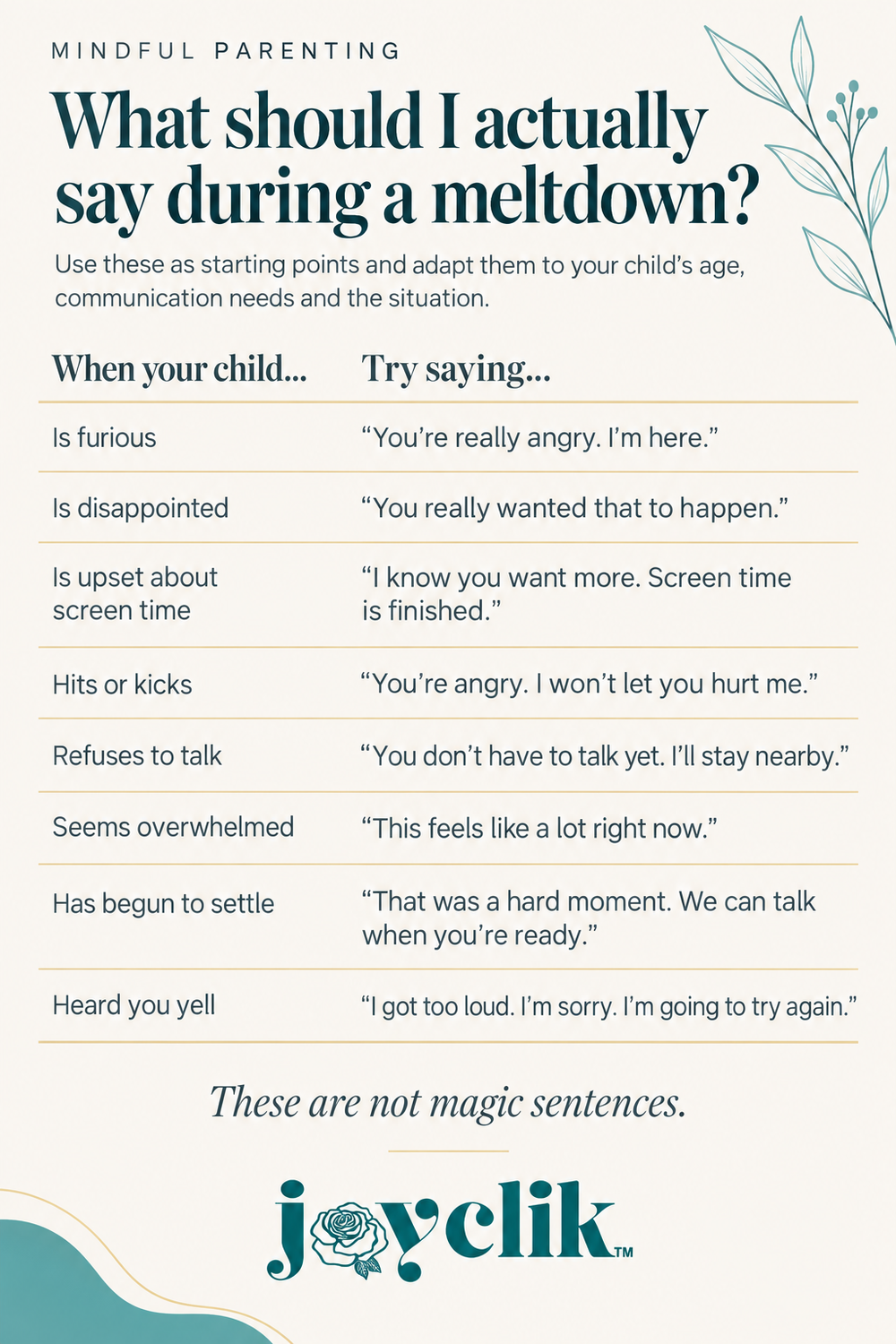
What should I actually say during a meltdown?
Knowing the principle is one thing; finding words under pressure is another. Use these as starting points and adapt them to your child’s age, communication needs and the situation.
| When your child… | Try saying… |
|---|---|
| Is furious | “You’re really angry. I’m here.” |
| Is disappointed | “You really wanted that to happen.” |
| Is upset about screen time | “I know you want more. Screen time is finished.” |
| Hits or kicks | “You’re angry. I won’t let you hurt me.” |
| Refuses to talk | “You don’t have to talk yet. I’ll stay nearby.” |
| Seems overwhelmed | “This feels like a lot right now.” |
| Has begun to settle | “That was a hard moment. We can talk when you’re ready.” |
| Heard you yell | “I got too loud. I’m sorry. I’m going to try again.” |
These are not magic sentences. Their value is that they help you communicate recognition, safety and a boundary without creating another argument.
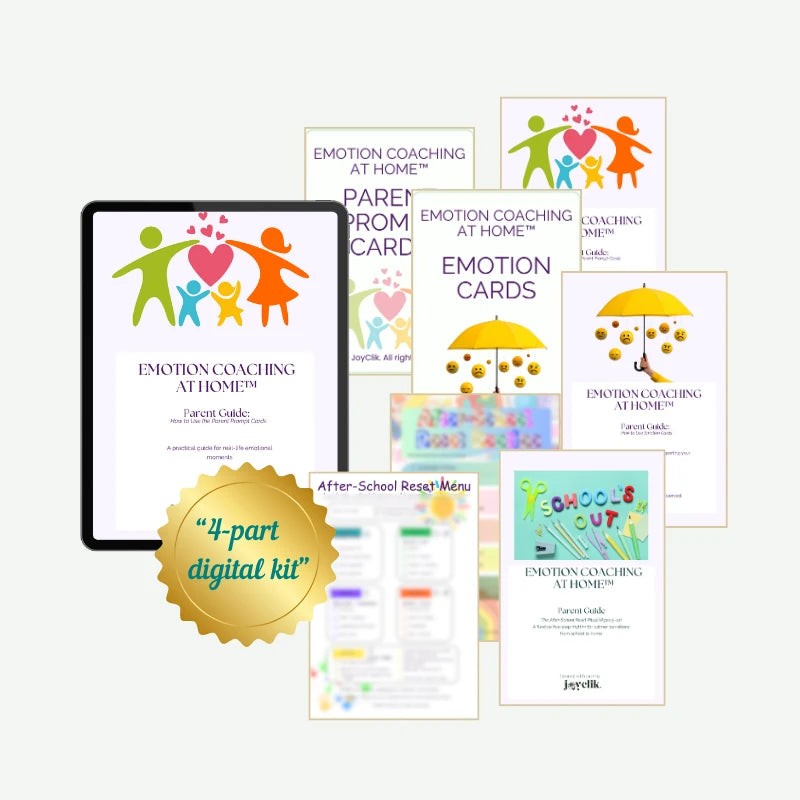
If having a few words to return to would help, our Emotion Coaching at Home™ brings together parent prompt cards, emotion cards and short guides. You can explore them during quieter moments, choosing language that feels natural to you and your child before the next difficult moment arrives.
What if my child keeps escalating?
You do not have to keep talking. More words can become more stimulation. Return to four essentials:
Safety: Move people or unsafe objects where needed and seek immediate help if anyone is at risk.
Calm: Reduce your volume, pace and unnecessary demands.
Boundary: State the limit briefly without repeatedly defending it.
Presence: Stay available in the way your child can tolerate - nearby, quieter or with more space.
If episodes are repeated, severe, difficult to keep safe, or affecting your child’s development, learning, relationships or daily functioning, speak with an appropriately qualified health or developmental professional. General parenting guidance cannot assess an individual child or family.
What if I am the parent who keeps yelling?
If yelling has become your default response, try not to turn that into another reason to attack yourself. Become curious about the pattern.
Ask:
- When do I yell most often?
- What happens immediately beforehand?
- What am I feeling in my body?
- What am I expecting my child to do in that moment?
- What would help me respond earlier?
You may discover that the final behaviour is only the last part of the story. The larger pattern may be noise, tiredness, rushing, repetition, mental load and feeling unheard.
Your first goal does not need to be, “I will never yell again.” A more realistic sequence is: “I want to notice sooner. I want to pause before I respond. When I get it wrong, I want to repair.”
A 60-second parent reset
Use STOP when you feel yourself reaching your limit:
S - Stop talking for a moment.
T - Take one slow, comfortable breath out.
O - Observe what is happening inside you.
P - Proceed with fewer words.
You are not practising becoming a perfectly calm parent. You are practising becoming a steadier parent. Calm Parenting Strategies offers more ways to build that pause before the most difficult moments.
Practical takeaways
- Regulate your response before trying to reason with a highly distressed child.
- Acknowledge the feeling without changing a necessary boundary.
- Use fewer words, a slower voice and clear safety limits.
- Connection can mean closeness, quiet presence or respectful space.
- Save teaching and problem-solving for after the emotional peak.
- Repair after yelling without making your child responsible for your reaction.
A gentle responsible-use note: This article provides general educational information and cannot assess your child, your family or the causes of a particular behaviour. Seek appropriately qualified support if you are concerned about safety, development, mental health, communication, sensory needs or day-to-day functioning. If anyone is in immediate danger, contact your local emergency service.
Frequently asked questions
What should I do first when my child is having a meltdown?
Begin by steadying your own response. Check safety, lower your voice, reduce your words and avoid trying to teach or reason while emotional intensity is very high. Acknowledge what feels hard and hold any necessary boundary.
Should I ignore my child’s tantrum?
Ignoring is not a universal response. Consider safety, your child’s age and needs, and whether they need space, reassurance, a boundary or your quiet presence. Staying calm does not require withdrawing emotionally from your child.
Should I talk to my child during a meltdown?
Use fewer words at the peak. A short statement such as “You’re really upset. I’m here” may be easier to process than questions or a lengthy explanation. Return to teaching and problem-solving after your child has more capacity to engage.
Can I validate my child’s feelings and still hold a boundary?
Yes. Validation acknowledges the emotional experience; it does not permit every behaviour or require you to change the answer. You can say both, “I understand that you’re angry” and “I won’t let you hit.”
What should I do after I yell at my child?
Repair without making your child responsible for your reaction. Acknowledge what you did, apologise clearly and describe what you want to try differently. You can repair the way you spoke while retaining an appropriate limit.
When should I seek professional help?
Seek individual guidance if episodes are severe, persistent, unsafe or significantly affecting your child’s development, learning, relationships or daily functioning, or if you are concerned about your own ability to respond safely. A qualified professional can consider your child’s needs and circumstances in a way a general article cannot.
Keep exploring the Mindful Parenting pathway
Topic: Big Feelings & Emotional Regulation
- Mindful Parenting Journal - practical articles for specific parenting questions.
- Mindful Parenting Guide - the wider landscape of calmer responses, connection, communication, routines and parent wellbeing.
- Wellness Knowledge Hub - explore all four JoyClik™ wellbeing pillars.
The supporting guide and optional practical toolkit shown below continue the pathway into deeper emotion-coaching guidance and words you can use at home.
References and further reading
- American Academy of Pediatrics, HealthyChildren.org. Screen Time & Temper Tantrums: Helpful Tips for Parents. Updated 2024.
- Raising Children Network. Meltdowns in autistic children and teenagers. Updated 2025.
- Raising Children Network. Helping children calm down: 3–8 years. Updated 2024.
- Center on the Developing Child at Harvard University. Serve and Return: Back-and-forth exchanges.
- Siegel, D. J., & Bryson, T. P. The Power of Showing Up: How Parental Presence Shapes Who Our Kids Become and How Their Brains Get Wired. 2020.

Mindful Parenting ArticlesBoundaries & Positive Discipline
Is Gentle Parenting Dead? What "Boundaries With Empathy" really means in 2026
Read article
Emotional Wellbeing ArticlesEmotional Regulation
Emotional Regulation: What It Is and 7 Gentle Ways to Practise It
Read article
Stress & Life Balance ArticlesMental Load & Energy