
JoyClik Wellbeing BlogStress & Life Balance ArticlesMental Load & Energy
The Mental Load at Home: Why Remembering Everything Is So Exhausting - and How to Share It
When you are the one remembering, planning and following up, help with chores may still leave you carrying the mental load. Explore what shared responsibility can look like - and how to begin with one realistic agreement.

Sharing the mental load means sharing responsibility for noticing, planning, remembering and following through - not only completing a task when asked. Begin with one recurring responsibility, agree what it includes and put the reminders with the person taking it on. Then check whether the arrangement has actually reduced the work someone else was holding in mind.
The school message needs a reply. There is almost no bread left. Someone needs a lift on Thursday, and the appointment you meant to book is still waiting.
You finally sit down, but part of you is still checking what might have been missed.
Perhaps other people in your household do plenty. Yet you remain the person who notices, remembers, asks and follows up. When someone says, “You should have told me,” it can be difficult to explain why that feels like another responsibility.
There is a name for this often unseen work: the mental load.
Understanding it can help you describe what feels heavy and begin a more useful conversation about how responsibility is shared.
What is the mental load?
The household mental load is the thinking involved in keeping daily life running: anticipating needs, remembering commitments, considering options and checking that things happen. Researchers describe this thinking work as cognitive household labour. It can remain with one person even when physical chores are shared. [1]
You might recognise it in knowing when the pet’s food will run out, remembering a family member’s appointment or checking whether someone has replied to the school.
The work is easy to miss because the result often looks ordinary: the right thing is available at the right time.
Is mental load the same as emotional labour?
The terms overlap in everyday conversation, but they are not interchangeable. Remembering and organising are cognitive work; supporting someone’s feelings involves emotional work. Researchers use different definitions of the wider mental load, with some including cognitive, managerial and emotional dimensions. [2]
For example, booking an appointment involves planning. Supporting a worried child before it involves emotional care. Both may take effort, but naming the particular responsibility makes it easier to discuss what support is needed.
Why can I feel overloaded when my partner helps?
Help with the visible task may leave the responsibility for organising it in the same place.
Consider a school trip. One adult might drive the child to school that morning. Another might have read the message, completed the form, checked the payment deadline, arranged the earlier start and remembered the packed lunch.
Both have contributed. A count of completed chores would miss part of the picture.
The example below illustrates the distinction. It is a conversation aid, not a test of who is the better partner.
| Part of the responsibility | Completing an assigned task | Taking responsibility for the agreed area |
|---|---|---|
| Noticing | Waiting to hear what is needed | Checking the relevant messages or supplies |
| Planning | Following arrangements someone else makes | Working out the steps and timing |
| Doing | Completing the requested action | Completing or arranging the action |
| Following through | Leaving someone else to check | Confirming completion and handling changes |
Shared responsibility can still involve questions and joint decisions. The aim is to avoid making one person the permanent source of instructions and reminders.
Why does remembering everything feel so tiring?
There may be no obvious finishing point. You can put away the laundry while still wondering about tomorrow’s arrangements. You can leave the house while remaining the person everyone contacts when something is missing.
A study of 322 mothers of young children examined planning and physical work across household tasks. A greater share of cognitive labour was associated with poorer wellbeing, including more reported stress and burnout. The findings were based on self-report and do not establish cause and effect. [1]
A separate study published in 2026 examined several dimensions of mental labour among 2,309 Italian mothers of one child. It found that practical support and relationship circumstances mattered to perceived differences in contribution. Its findings describe that population, rather than every household. [2]
These studies give attention to work that can otherwise go unrecognised. They do not mean every tired person has an unequal household arrangement, or that every family follows the same gender pattern.
You also do not need a research statistic to begin describing your own experience: “I am finding it difficult to switch off because I am still responsible for what happens next.”
How do I explain the mental load without starting an argument?
Choose a specific example and a time when there is some room to listen. A conversation about one responsibility is usually easier to make concrete than a debate about who does everything.
You could begin:
“I appreciate that you do the shopping. I’m still checking what we need, planning the meals and answering questions while you’re there. Could we look at how to share that part too?”
Or:
“I’m finding it hard to switch off because I keep track of what needs to happen next. Could we choose one area that you take responsibility for, including the reminders and follow-up?”
These are suggested words to adapt, not a script you have to deliver perfectly. Clear wording can help someone understand; it cannot make another person willing to listen or act.
Make space for responsibilities you may not see in each other’s day. Paid work, caring commitments, health and access to support all belong in the conversation. A fair arrangement needs to consider the whole household and each person’s realistic capacity. For more on protecting time and emotional capacity through clearer expectations, explore Work-Life Balance and Healthy Boundaries.
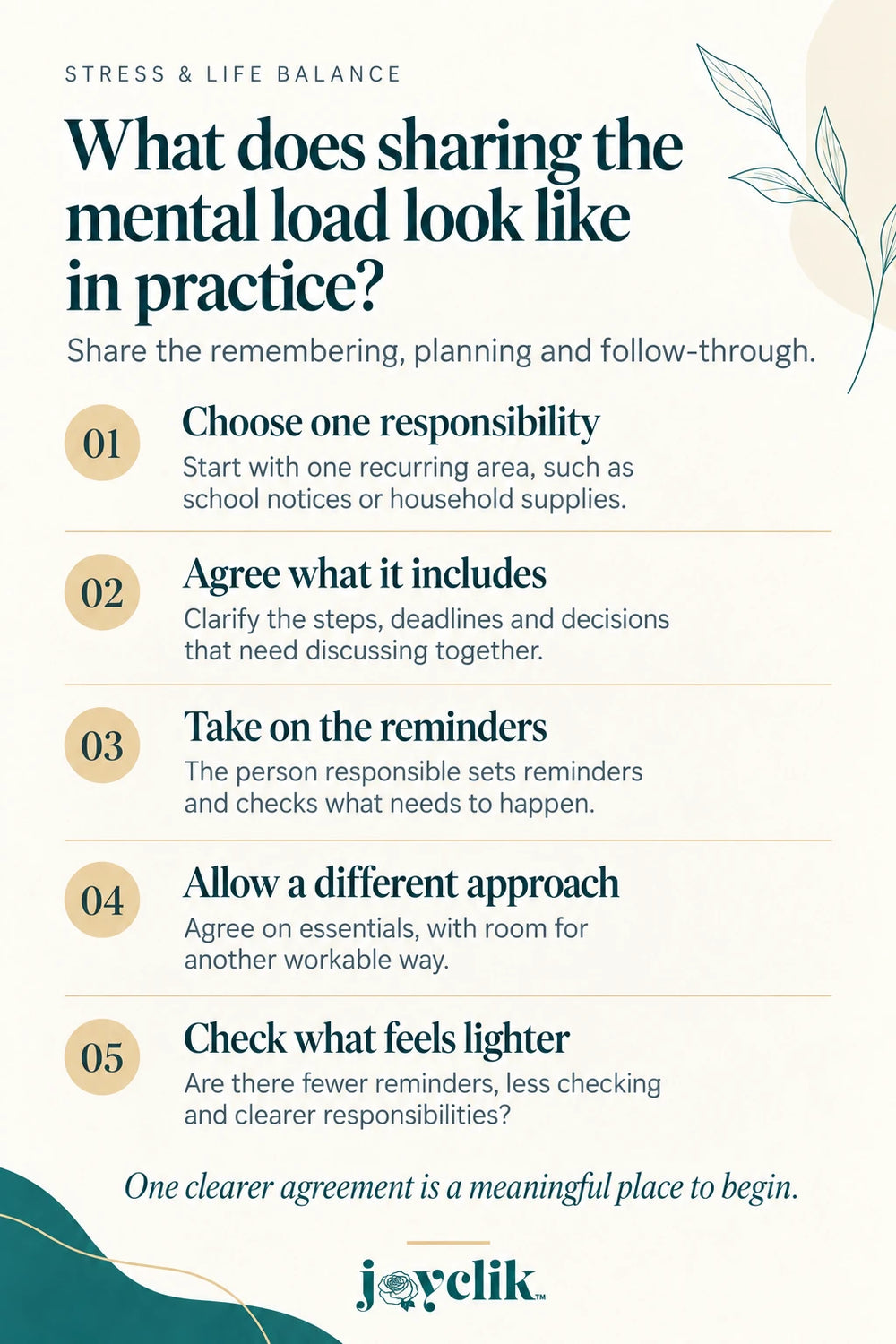
What does sharing the mental load look like in practice?
The following steps are practical suggestions for everyday household conversations, rather than a tested treatment or a requirement to reorganise your whole life.
1. Begin with one recurring responsibility
Choose something that creates repeated reminders or uncertainty: school notices, household supplies or arranging transport, for example.
Describe what happens around the visible task. What needs noticing? What information is needed? What happens when plans change?
Keep this small enough to discuss without spending an evening documenting your entire household.
2. Agree what the responsibility includes
“Handle school notices” might mean checking the messages, noting deadlines, completing forms and flagging decisions that need both adults.
Agree what requires consultation and what the person can decide independently. Make sure they have the necessary access, information and authority to act.
That is different from handing over a task while retaining every decision about how it must happen.
3. Put reminders with the person responsible
A calendar or list is useful only if the people using it take responsibility for checking it.
If you are taking over an area, set your own reminders and arrange access to the relevant messages. Ask necessary questions, then record the answers somewhere you can find them.
The household should not need one person to remember to remind everybody else.
4. Allow room for a different approach
Agree on essentials such as safety, deadlines, budget and genuine needs. There may be more than one workable way to manage the rest.
If you have carried an area for a long time, stepping back may feel uncomfortable. If you are taking it on, reliable follow-through matters more than promising that the other person can relax.
Trust has something to grow from when agreements are kept.
5. Check whether anything actually became lighter
After trying the arrangement, ask:
- Did reminders reduce?
- Does each person know what they are responsible for?
- Is information accessible without repeatedly asking one person?
- Does the arrangement fit current capacity?
A missed detail may call for a better reminder or clearer agreement. It does not automatically mean responsibility must return to the person who held it before.
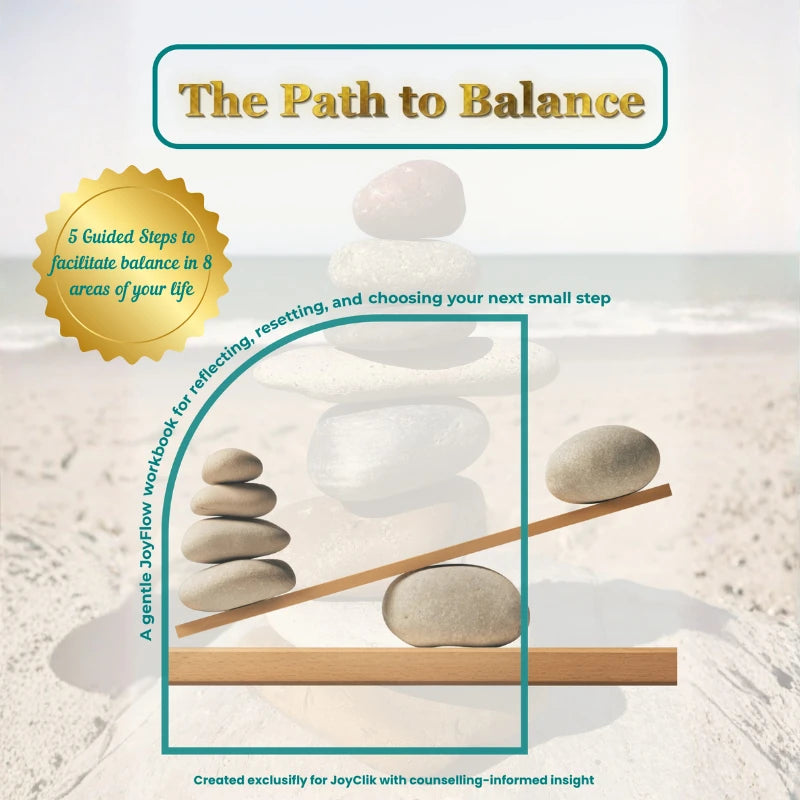
If household pressure has brought a wider imbalance into focus, The Path to Balance offers guided reflection across eight life areas using the JoyFlow Balance Wheel™. It can help you choose a realistic priority; sharing the household load still requires practical agreements and follow-through.
What if there is nobody available to share it?
Advice about dividing responsibilities can feel distant when you parent alone, care for someone with significant needs or have very little practical support.
In that situation, it may help to look for one demand that can become simpler, less frequent or unnecessary. That might mean repeating a straightforward meal, stepping back from an optional commitment or asking a trusted person for one specific, manageable form of help.
Keep a short list for essential commitments if it helps, without turning every part of life into something to track. You do not have to carry every demand as equally urgent.
Financial pressure, disability, care needs and limited services can constrain what is possible. A heavy load is not proof that you have failed to organise yourself well enough. If you are caring for children, Mindful Parenting Self-Care offers further support for your own capacity.
If you are reconsidering what is manageable in this season, How to Create More Balance in Life Without Chasing Perfection explores priorities, capacity and room for recovery.
What if conversations never lead to change?
There is a difference between an arrangement that needs practice and repeated unwillingness to take responsibility.
If the same discussion keeps returning, it may be useful to name the pattern: “We agree this will change, but I am still doing the reminders and follow-up. What can we realistically commit to?”
If you feel intimidated, controlled or unsafe raising your needs, prioritise appropriate individual support rather than trying to find a better household script.
Practical takeaways
- Name the thinking work. Remembering, planning and checking are part of a responsibility.
- Choose one area to discuss. An ordinary example can make an invisible burden easier to understand.
- Agree on follow-through. Include reminders, information and what happens when plans change.
- Notice whether the load becomes lighter. A new list is only useful if responsibility changes with it.
You might begin with one question: “What am I still keeping track of after someone else has helped?”
A gentle responsible-use note: This article offers counselling-informed education and practical ideas for everyday wellbeing. It is not a diagnosis or a replacement for therapy, medical advice or personalised professional care. If exhaustion, distress or relationship difficulties persist or interfere with daily life, consider support from an appropriately qualified professional. Mental load is one possible contributor to feeling depleted; it should not be assumed to explain every symptom.
Frequently asked questions
What is an everyday example of the mental load?
Noticing that school forms need completing, checking the deadline, arranging payment and remembering to follow up are all thinking work around a visible task. Sharing that work means agreeing who will keep track of the whole responsibility.
How is sharing the mental load different from helping with chores?
Someone can complete a chore while another person still notices what is needed and organises it. Shared responsibility includes the planning and follow-through, with clear agreements about decisions that need both people.
Does a fair arrangement have to be exactly fifty-fifty?
No. Consider each person’s health, paid work, caring commitments and available capacity. A useful arrangement is understandable, realistic and open to review; counting tasks alone can miss the thinking involved.
What if a shared list becomes another job for me?
Agree who will maintain and check it. A list can make information easier to find, but it will not share responsibility if one person still has to update everything and remind everyone to look.
Keep exploring the Stress & Life Balance pathway
Topic: Mental Load & Energy
- Stress & Life Balance Journal - practical articles for specific everyday questions.
- Stress & Life Balance Guide - the wider picture of pressure, energy, boundaries and a sustainable daily rhythm.
- Wellness Knowledge Hub - explore all four JoyClik™ wellbeing pillars.
The supporting guide and optional practical resource shown below continue the pathway into clearer boundaries and reflection on what needs more support.
References and further reading
- Aviv, E., Waizman, Y., Kim, E., Liu, J., Rodsky, E., & Saxbe, D. (2025; first published online 1 July 2024). Cognitive household labor: Gender disparities and consequences for maternal mental health and wellbeing. Archives of Women's Mental Health, 28, 5–14. https://doi.org/10.1007/s00737-024-01490-w
- Vettoretto, E., Minello, A., Ortensi, L. E., & Tosi, F. (2026). Understanding the dimensions of mental labor: The invisible load of Italian mothers. Frontiers in Sociology, 10, Article 1683261. Published 29 January 2026 in the journal’s 2025 volume. https://doi.org/10.3389/fsoc.2025.1683261

Stress & Life Balance ArticlesBalance
How to Create More Balance in Life Without Chasing Perfection
Read article
Stress & Life Balance ArticlesMindful Daily Habits
The Joy Prescription: Daily Stress-Relief Rituals That Fit Real Life
Read article
Emotional Wellbeing ArticlesEmotional Regulation