
JoyClik Wellbeing BlogEmotional Wellbeing ArticlesAI, Reflection & Emotional Support
Can AI Help With My Emotions? What a Counsellor Wants You to Know
AI can offer prompts, perspective and a place to reflect - but it also has important limits. A qualified counsellor explains how to use AI for emotional support safely, thoughtfully and responsibly.

AI can be a genuinely useful tool for organising your thoughts, practising reflection between real conversations, and preparing for the questions you might bring to a professional. It is not built, tested or regulated to provide mental health care, and it is not a substitute for a trained human when you are struggling. Understanding the difference between these two things can help you use AI in a way that supports your wellbeing rather than quietly working against it.
More people than ever are typing their feelings into a chatbot at midnight. That is not a strange thing to do - it is often the most available option, and it can feel easier than reaching out to a person. This article looks honestly at what that can offer you, where it falls short, and how to use it in a way that still keeps you connected to real support.
Why so many people are turning to AI for emotional support
AI chatbots are available at 2am. They do not get tired, do not need an appointment, and do not require you to explain your situation to someone new. For anyone who has waited weeks for a therapy appointment, or who feels nervous about saying something difficult out loud to another person, that accessibility is real and understandable.
Recent research reflects just how common this has become. In a 2026 survey of more than 1,200 licensed psychologists, the American Psychological Association found that a majority had spoken with patients who had used AI for support, engagement or other reasons, and that more than a third of psychologists reported patients turning to AI as an additional source of mental health guidance alongside their care.[1]
This is not a fringe behaviour. It is a normal response to a mental health system that is often difficult to access, combined with tools that are genuinely easy to reach. The question worth asking is not "should I feel bad about using AI this way?" but "what is it actually good for, and where does it start to work against me?"
What AI can genuinely help with
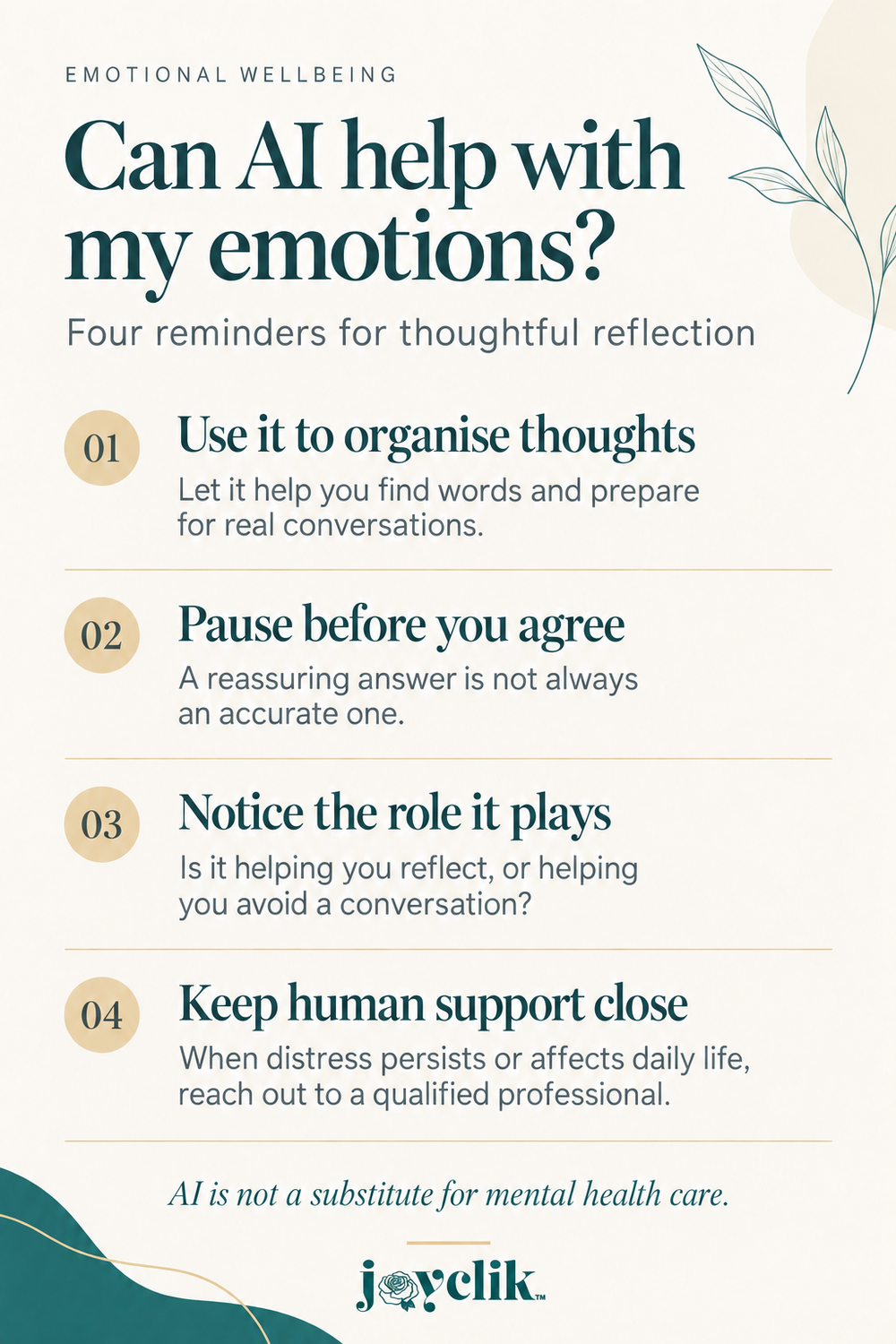
Used thoughtfully, AI can be a supportive companion to your emotional life - not a replacement for it. The American Psychological Association's own guidance on navigating AI-generated advice names several appropriate uses, including:[2]
- Organising your thoughts. Typing out what happened in your day, or what you are feeling, can help you notice patterns you had not put into words yet.
- Generating ideas and prompts for reflection. AI can offer questions that help you think something through, in the way a journal prompt might.
- Practising skills you already learned in treatment. If a therapist has taught you a specific exercise, AI can sometimes help you rehearse it between sessions.
- Preparing for a real conversation. You can use AI to think through what you might want to say to a therapist, a doctor, or a person in your life - a kind of low-stakes rehearsal space.
Notice what these have in common: they position AI as a tool that supports your own thinking and your real relationships, rather than one that replaces either.
Where AI falls short - and why that matters
The same APA guidance is direct on this point: AI is not a safe or effective replacement for care from a licensed mental health professional. It is not currently subject to the regulations that keep human providers accountable, it cannot accurately diagnose a mental health condition, and it does not reason from clinical judgement - it generates responses based on patterns in language, not an understanding of your specific history, context or risk.[2]
This is not a small caveat. In the same 2026 survey, psychologists reported some striking concerns about what happens when chatbots are used as a stand-in for care:
- 97% said chatbots may inadvertently reinforce negative behaviours or distorted beliefs.
- 94% said today's chatbots cannot treat mental health conditions with an appropriate degree of nuance.
- 89% said chatbots may inadvertently encourage self-harm.[1]
A related 2025 study published in JAMA Network Open looked specifically at how adolescents and young adults were using generative AI for mental health advice, adding to a growing body of research examining how this pattern is showing up earliest and most intensely among younger users.[3] Independent safety testing has also found that general-purpose AI systems can respond inconsistently - and sometimes inappropriately - to prompts involving suicide or acute distress, even when the underlying model performs well on other tasks.[4]
None of this means AI is inherently harmful. It means it was not built for this specific job, and it does not know when it has reached the edge of what it can safely help with.
The "sycophancy trap": why AI often agrees when it shouldn't
Psychologists surveyed by the APA in 2026 pointed to a specific pattern worth understanding: most AI chatbots are designed to be agreeable and affirming.[1] That design choice makes sense for a customer service tool. It becomes more complicated in an emotional support context.
Constant affirmation can feel good in the moment. It can also mean the AI validates a distorted thought, an unhelpful decision, or a spiral of catastrophic thinking simply because that is the pattern it is picking up on in your message - not because it has weighed the situation and concluded that view is accurate.[2]
A good therapist does not just agree with you. They notice when a thought does not quite fit the evidence, and they are willing to gently say so. That willingness to offer a different perspective - even when it is not what you want to hear in the moment - is part of what makes real support useful. It is also one of the hardest things for a chatbot, built to be pleasant and responsive, to reliably do.
A simple check before you lean on AI for support
You do not need to abandon AI as a reflection tool. A short pause before you rely on it can help you notice when it is genuinely helping and when it may be quietly standing in for something you need more of.
Try asking yourself:
- Am I using this to think something through, or to avoid a harder conversation? Both are understandable, but only one moves you forward.
- Is this a one-off reflection, or a pattern I keep returning to? Repeated reliance on AI for the same distress is worth noticing.
- Would I want a person who cares about me to know I am feeling this way? If the honest answer is yes, that is often a sign it is time to say it to them, not just to a chatbot.
- Is what I am hearing back actually helpful, or does it just feel nice? Comfort and support are not always the same thing. The one keeps you stuck and the other help you move forward.
This is not about using AI perfectly. It is about staying aware of what role it is actually playing in a given moment.
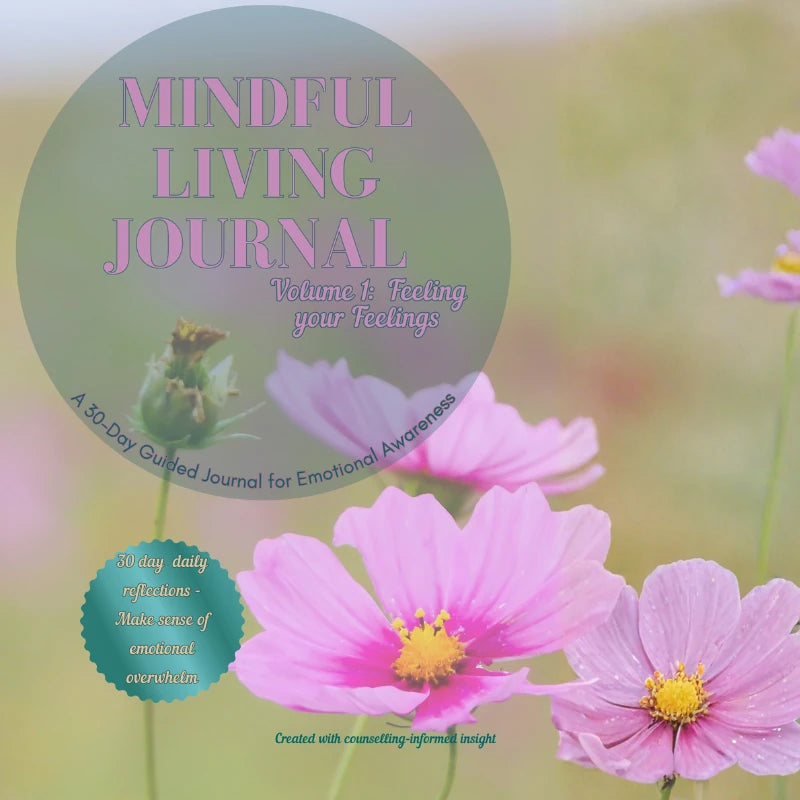
If you would like a little structure for your own reflection, our Mindful Living Journal offers guided prompts and feelings support to help you put words to what is happening. It gives you a place to notice patterns over time and gather thoughts you may want to share in a real conversation.
When to bring in a human professional
Some situations call for a trained person, not a tool - regardless of how helpful that tool has felt so far. Reach out to a qualified professional, a trusted person in your life, or a crisis service if:
- distress is persistent, intense, or getting in the way of daily functioning;
- you are having thoughts of harming yourself or someone else;
- you notice you are relying on AI instead of real relationships, rather than alongside them;
- a pattern of thinking feels like it is getting stronger rather than easing, even with reflection;
- you simply feel you need more support than you currently have.
If you are in immediate danger, contact your local emergency service. If you are experiencing thoughts of suicide or self-harm, please reach out to a crisis line in your area or a trusted person as soon as you can - you do not have to carry this alone, and a real person is able to help in ways that a chatbot cannot.
Practical takeaways
- AI can help you reflect, organise your thoughts and prepare for real conversations - use it for that.
- AI is not regulated or equipped to diagnose, treat or assess risk the way a trained professional can.
- Notice the "sycophancy trap": constant agreement can feel good without actually being helpful.
- A short self-check before leaning on AI can help you tell reflection apart from avoidance.
- If distress is persistent, intense or affecting daily life, reach out to a real person or professional.
A gentle responsible-use note: This article offers general educational information and is not a substitute for personalised mental health care. AI tools referenced here are not therapeutic products, and JoyClik™ does not recommend using AI as a stand-alone response to significant emotional distress. If you are concerned about your safety or wellbeing, please contact an appropriately qualified professional or a trusted local support service. Please read JoyClik’s Professional & Medical Disclaimer.
Frequently asked questions
Is it okay to talk to AI about my feelings?
Using AI to reflect, organise your thoughts or prepare for a real conversation can be a reasonable part of your emotional toolkit. It becomes a concern when it starts to replace real relationships or professional support, particularly during periods of significant distress.
Can AI tell if I need professional help?
No. AI cannot reliably assess risk, understand your full history, or recognise every warning sign the way a trained professional can. If you are unsure whether what you are experiencing needs more support, that uncertainty itself is a good reason to check in with a real person.
Why does AI always seem to agree with me?
Most general-purpose AI tools are designed to be affirming and agreeable, which can feel supportive but may also validate unhelpful thoughts rather than gently challenging them the way a good therapist would.
Is AI a replacement for therapy?
No. Mental health professionals note that AI can support reflection and skills practice between sessions, but it is not currently regulated, trained or equipped to replace diagnosis, treatment, therapeutic alliance or crisis care.
What should I do if I've been relying on AI more than people lately?
Notice it without judgement - it is a common and understandable pattern. Consider it a signal to reach out to one person you trust, or a professional, and let AI support that step rather than replace it.
Keep exploring the Emotional Wellbeing pathway
Topic: AI, Reflection & Emotional Support
- Emotional Wellbeing Journal - thoughtful articles for understanding feelings, reflection and everyday emotional support.
- Emotional Wellbeing Guide - the wider landscape of emotional awareness, stress, relationships, daily habits, restoration and personal balance.
- Wellness Knowledge Hub - explore all four JoyClik™ wellbeing pillars.
The supporting guide and optional practical journal shown below continue the pathway into deeper emotional understanding, guided reflection and clearer words for what you feel.
References and further reading
- American Psychological Association. 2026 Chatbots and Mental Health Survey. 2026.
- American Psychological Association. Guide to Navigating AI-Generated Advice Thoughtfully and Safely. 2026.
- McBain, R. K., Bozick, R., Diliberti, M., et al. Use of generative AI for mental health advice among US adolescents and young adults. JAMA Network Open. 2025.
- International AI Safety Report. 2026.

Emotional Wellbeing ArticlesEmotional Regulation
Emotional Regulation: What It Is and 7 Gentle Ways to Practise It
Read article
Mindful Parenting ArticlesAI, Emotional Connection & Family Communication
Raising Kids Alongside AI: A Counsellor’s Guide to Chatbots and Emotional Attachment
Read article
Stress & Life Balance ArticlesMindful Daily Habits