
JoyClik Wellbeing BlogMindful Parenting ArticlesAI, Emotional Connection & Family Communication
Raising Kids Alongside AI: A Counsellor’s Guide to Chatbots and Emotional Attachment
Why can an AI chatbot feel like a friend to a child? Explore what to notice, how to talk about it and ways to support connection while holding clear boundaries.

If your child talks to an AI chatbot about their feelings, start by finding out what those conversations mean to them. Notice the app, its suitability for their age, the content and any changes in sleep, relationships or daily life. A calm conversation can sit alongside a firm boundary. A chatbot should not become a child’s only source of support.
You thought your child was looking something up. Then they mention that a chatbot knows about an argument with a friend, remembers something personal, or is “the only one who understands”.
It can be difficult to know what to do with that. Should you ask to see the conversation? Stop access? Worry that you have missed something?
You do not need a perfect understanding of artificial intelligence to begin. You need a little context, a willingness to listen and clear decisions about what is suitable for your child. This guide looks at children, AI chatbots and emotional attachment, with practical words for conversations that may feel unfamiliar.
For the wider picture of connection, communication and boundaries, our Mindful Parenting Guide brings these everyday parenting skills together.
What is the difference between an AI tool and an AI companion?
A general-purpose chatbot can answer questions, generate ideas and help with tasks. An AI companion is designed to encourage an ongoing personal connection, often through a character, personality or simulated relationship. The distinction matters, although a child may also use a general-purpose tool for companionship. Neither category should be assumed to provide appropriate mental-health care. [1]
Ask which service your child means and what happens there. “Using AI” could describe a supervised learning activity or a private, late-night conversation about feeling alone. Those situations call for different decisions.
Why can a chatbot feel like a friend?
A quick reply can feel reassuring. A warm tone, personalised response or remembered detail can give the impression that someone is paying close attention. For a child who finds it difficult to begin a conversation, that experience may feel easier than approaching another person.
The American Academy of Pediatrics warns that human-like chatbot design can encourage children to trust these systems and form attachments. A response that sounds caring is not the same as the responsibility and understanding available in a safe human relationship. [2]
Knowing that a chatbot is software does not necessarily make the feelings disappear. Equally, children differ in how clearly they understand what the system is doing. Rather than assuming, ask what your child believes the chatbot knows about them and what they expect it to do.
If your child values the conversation, dismissing it as silly may make it harder to understand their experience. You can acknowledge that something felt comforting while still questioning whether the service is suitable.
And if you have been busy, tired or unavailable at times, this is not evidence that you have failed. Parents are human. Your child needs relationships with room for pauses, repair and more than one trusted person.
What does the research actually show?
The evidence gives parents reasons to pay attention, but it does not justify treating every chatbot conversation as a sign of harm.
Some children describe chatbot conversations as friendship-like
Internet Matters’ 2025 UK research included children aged 9–17. Among those who had used AI chatbots, 35% said the experience felt like talking to a friend. This describes reported feelings among chatbot users; it does not mean that one-third of all children have replaced their friends with AI. [3]
Emotional-support use can be a reason to ask what else is happening
A 2026 University of Ottawa report described a survey of 39,761 students in grades 4–12 across four Ontario school boards. About 21% reported using a chatbot for help with feelings or relationships. This use was associated with greater emotional difficulties and loneliness. The findings do not establish whether AI caused those difficulties: a child who is already struggling may be more likely to seek support this way. [4]
Some teenagers describe struggling to step away
Drexel researchers analysed 318 Reddit posts from self-identified teenagers who were discussing dependency or overreliance on Character.AI. Some described disrupted sleep, strained relationships and difficulty reducing their use. Because the study specifically selected posts about these problems, it cannot tell us how common they are among all teenage users. [5]
These are different kinds of evidence. Surveys can show patterns; accounts of difficult experiences can help us understand what those experiences feel like. Neither gives a parent a diagnosis for their own child. The useful next question is: What is this conversation providing, and what else might my child need?
Quick reference: what should parents notice?
Look at changes over time and what the conversations contain. The comparison below is a reflection aid, not a test of whether an app is safe or a checklist for diagnosing dependency. Even brief use can expose a child to inappropriate responses. [2]
| Area | What you might notice | When more support or a boundary is needed |
|---|---|---|
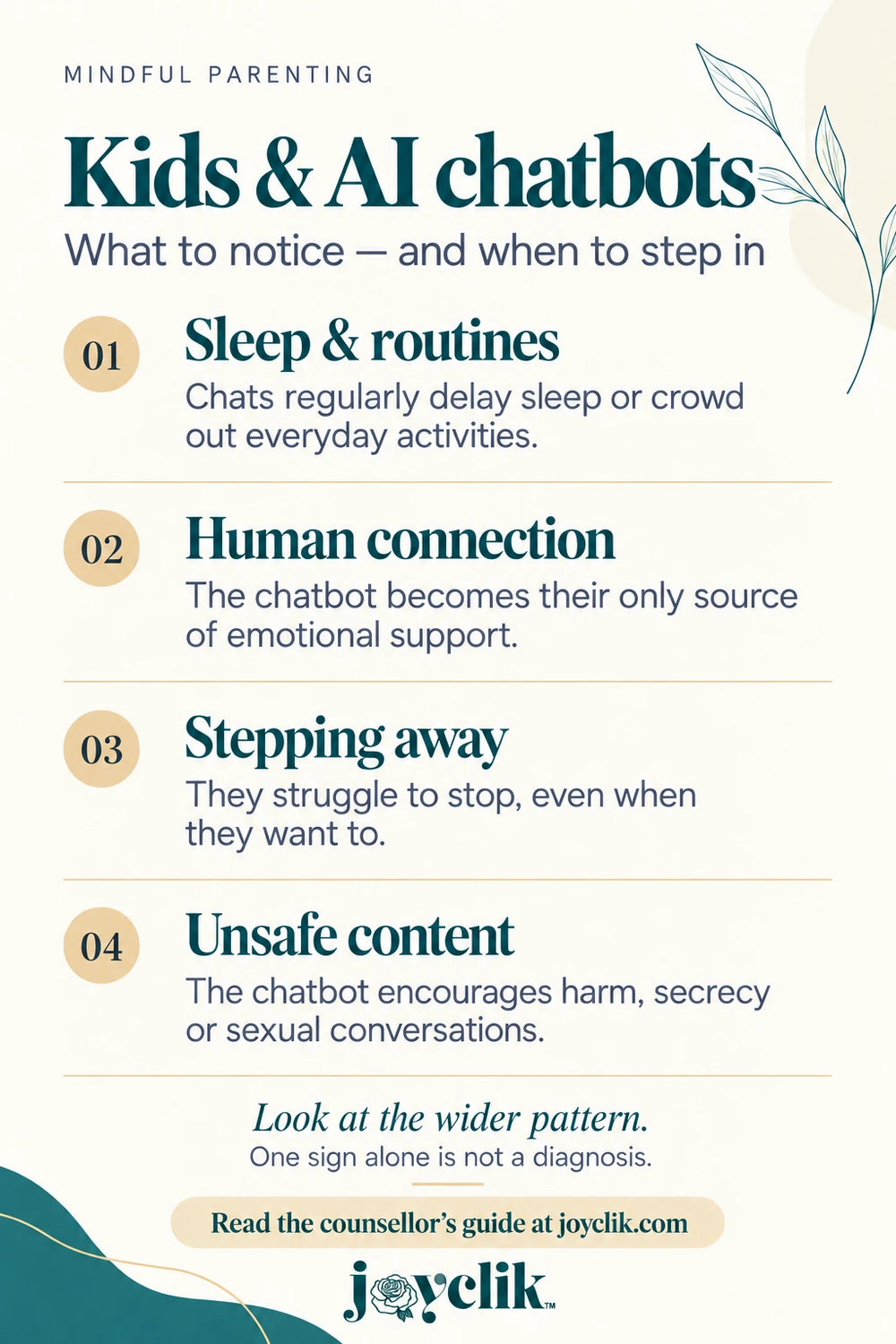
| Sleep and routines | Use fits around sleep, school and other activities. | Chats regularly delay sleep or crowd out everyday activities. |
| Human connection | Your child still turns to trusted people. | The chatbot becomes their only source of emotional support. |
| Stepping away | They can finish a chat and move to another activity. | They struggle to stop, even when they want to, or repeatedly return despite problems. |
| Content and privacy | You can discuss the service and agree suitable oversight. | The chatbot encourages harm, secrecy or sexual conversations, or personal information has been exposed. |
A wish for privacy, one upset reaction or playful “friend” language does not establish harmful attachment. Ask about context rather than using one behaviour as proof. Unsafe content, however, deserves a response even if everything else seems unchanged.
A counsellor’s approach: how to talk to your child about AI chatbots
Choose a moment with enough space to listen. The following are original conversation examples to adapt to your child’s age, communication needs and situation. They are starting points, not scripts that guarantee a particular response.
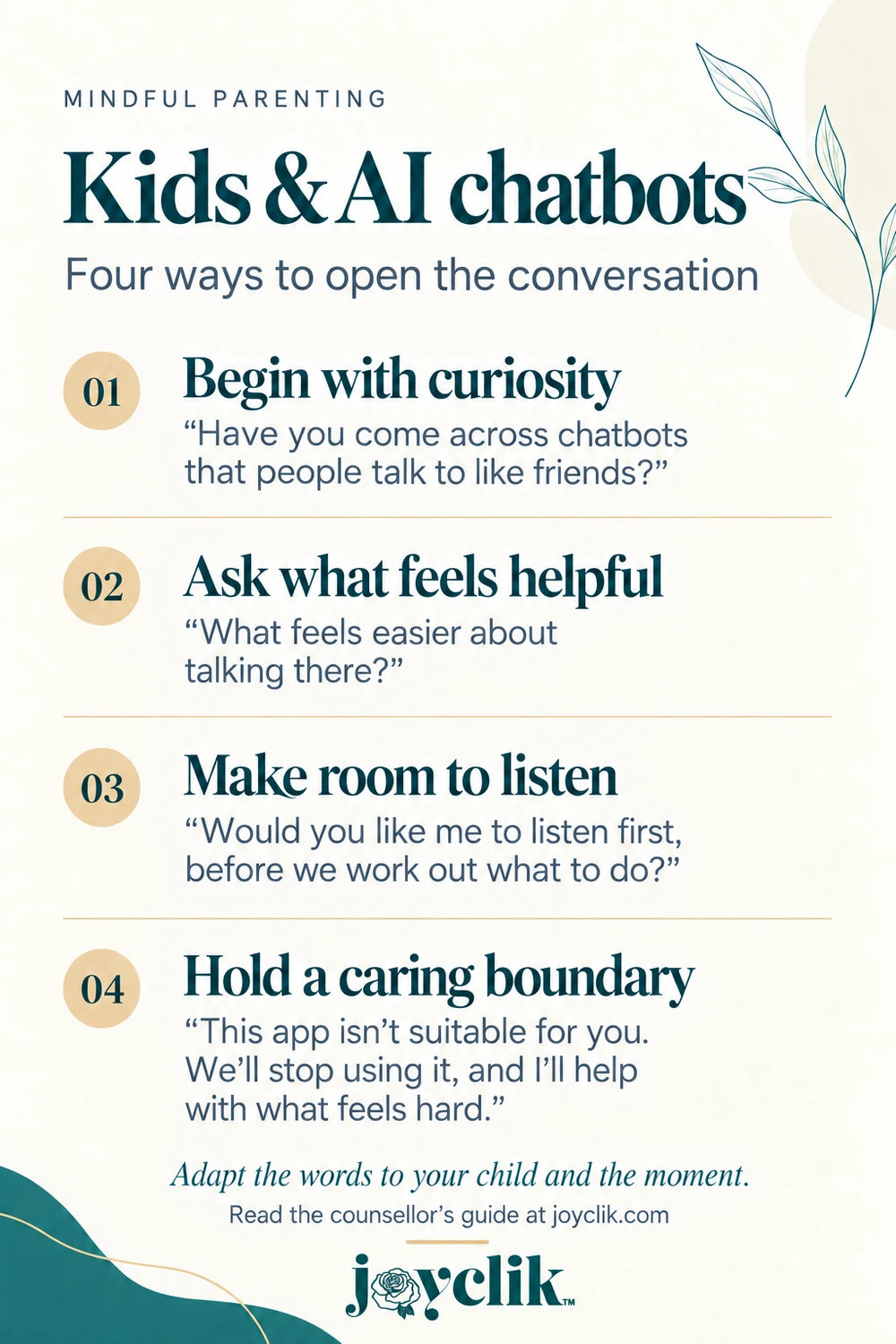
1. Begin with curiosity
“Have you come across chatbots that people talk to like friends?”
This leaves room for your child to tell you about something they have seen, heard about or used. If you already know they have been chatting, be straightforward about that rather than setting a trap.
2. Ask what feels helpful
“What feels easier about talking there?”
Perhaps there is no interruption, no visible reaction or no need to find the right moment. Listen for the need underneath the answer. You can understand the appeal without approving the app.
3. Make room to listen
“Would you like me to listen first, before we work out what to do?”
If they say, “It understands me better than you,” you might respond: “It sounds like you have felt heard there. I want to understand what I have been missing.” You do not have to prove that you are the better listener in that moment.
Later, explain the difference in ordinary language: a chatbot produces responses, but it cannot take responsibility for their wellbeing or be there in the ways a trusted person can.
4. Hold a caring boundary
“This app isn’t suitable for you. We’ll stop using it, and I’ll help with what feels hard.”
Listening does not remove your responsibility to act. Explain the reason for the boundary and what happens next. If the attachment feels intense, take your child’s distress seriously and arrange appropriate support alongside the restriction.
5. Leave a way back into the conversation
If they do not want to talk, try: “You don’t have to explain everything now. We do need to sort out what is safe. We can come back to the rest.” Offer another trusted adult if that would make sharing easier.
For more examples of listening, checking your understanding and returning after a difficult exchange, explore Positive Parent–Child Communication. Our article on boundaries with empathy also explains how a clear limit can leave room for feelings.
What boundaries make sense for children and teenagers?
Check the service’s current minimum age and safeguards. Meeting an age requirement does not establish that every feature is suitable. The AAP’s guidance highlights Common Sense Media’s recommendation against social AI companion use for under-18s. That is a specific caution about companion services, rather than a verdict on every supervised use of AI. [1]
For younger children
Keep explanations concrete and any permitted, age-appropriate activity closely supported by an adult. A younger child needs help understanding that a friendly reply is generated by software. Do not assume independent private conversations are suitable because a service looks playful.
For teenagers
Discuss which features are available, what information is being shared and what the conversations are providing. Explain any oversight honestly. Give your teenager a voice in household arrangements while remaining clear about safety limits.
A manageable family agreement can cover devices at bedtime, which services are permitted and who to approach after an upsetting response. Treat personal details, school information, images and other people’s stories as information to protect. A chatbot is not a confidential diary. Privacy settings and parental controls can help, but they do not make a service risk-free. [2]
When is extra support needed?
If your child’s mood, sleep, relationships or participation in daily life are persistently affected, speak with a GP, paediatrician or appropriately qualified child or adolescent mental-health professional. You do not need to establish that the chatbot caused the difficulty before asking for help. Mention the service and the changes you have noticed.
If a chatbot encourages self-harm, violence or sexual activity, stop the interaction and take the content seriously. If your child may be in immediate danger, stay with them and contact local emergency or urgent mental-health services. A chatbot or a wellbeing journal is not crisis support.
Making space for conversations that do not begin easily
Alongside decisions about technology, it can help to create an ordinary opening for connection. It does not have to become a long discussion about AI every evening.
At a settled moment, offer one small question: “Was there anything today you wanted someone to understand?” You might share something brief from your own day first, without asking your child to take care of your feelings.
Let the answer be short. Talking during a walk, drawing together or returning to a question another day may fit better than sitting face-to-face. If your child passes, avoid turning the invitation into a test of trust.
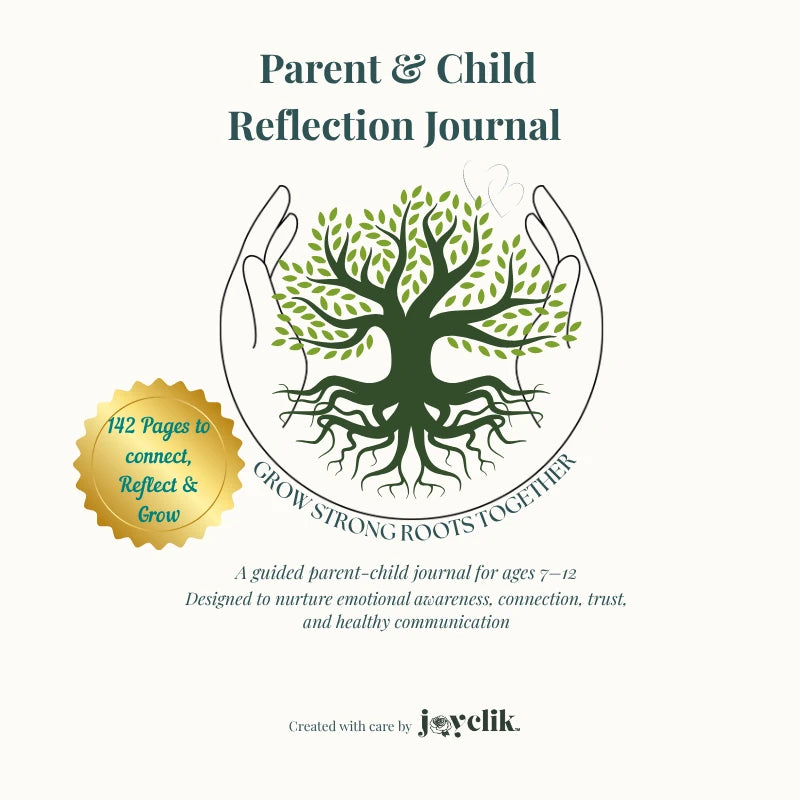
For parents and children aged 7–12, the Parent & Child Reflection Journal offers a shared place to begin. Its guided pages make room for feelings, appreciation, weekly reflection and repair after difficult moments. Choose a relevant page and talk, write or draw together at your own pace.
You can use selected fillable spaces digitally or print pages for time together away from a screen. The journal supports everyday reflection; it is not a treatment for chatbot dependency or a replacement for professional care.
Explore the Parent & Child Reflection Journal →
Delivery - Instant digital download after checkout; no physical product is supplied.
With an older teenager, adapt the invitation to their interests and preferred way of talking. The aim is to keep human support available without requiring them to disclose everything.
Practical takeaways
- Find out what the conversations mean. Ask about the service and what your child finds helpful.
- Look at the wider pattern. Notice sleep, relationships, content and difficulty stepping away.
- Listening and limits belong together. Understanding a feeling does not require allowing an unsuitable app.
- Keep support human and accessible. Make room for trusted adults, peers and professional help when needed.
- Begin with one manageable opening. A shared question or reflection page can offer a place to start.
You do not need to solve every question about AI today. Start with what your child is experiencing and the next decision that needs your attention.
A gentle responsible-use note: This article offers general, counselling-informed education for parents and caregivers. The examples are illustrative, not a personalised parenting plan or a replacement for therapy, medical advice or developmental assessment. If distress, aggression, relationship difficulties or your own reactions are persistent, intense or affecting safety and daily life, seek support from an appropriately qualified professional. Your family’s needs may call for a more individual approach.
Frequently asked questions
Are AI chatbots safe for kids?
There is no single safety verdict for every chatbot. The design, content, age requirements and circumstances matter. Friendly wording is not a safeguard, and inappropriate advice can appear during brief use. Review the specific service before deciding whether any use is suitable.
Is it normal for a child to think of a chatbot as a friend?
Some children report friendship-like feelings. That does not make the chatbot a reciprocal friend or establish that the relationship is harmless. Ask what “friend” means to your child and notice whether they still have people they can turn to.
Can AI chatbots cause emotional dependence?
Some young people describe dependence-like experiences, including difficulty stopping despite problems. Existing studies do not establish a single cause or predict which individual child will struggle. Focus on the impact and seek advice when your child needs help.
Should I ban my child from using a chatbot?
Restricting an unsuitable service can be appropriate. Consider age, content and your child’s needs rather than treating all AI activities alike. Explain the decision, acknowledge any disappointment and offer support with what they had been seeking from the chat.
What if my child talks to AI instead of me?
Ask what makes that conversation feel easier, and listen to the answer before defending yourself. Offer a manageable way to reconnect and access to another trusted person. If AI is becoming their only source of support, seek help with the wider situation.
Keep exploring the Mindful Parenting pathway
Topic: AI, Emotional Connection & Family Communication
- Mindful Parenting Articles - explore practical questions from everyday family life.
- Mindful Parenting Guide - the wider picture of communication, connection and caring boundaries.
- Wellness Knowledge Hub - explore all four JoyClik wellbeing pillars.
For an adult-focused perspective, read Can AI Help With My Emotions? What a Counsellor Wants You to Know.
The communication guide and Parent & Child Reflection Journal below offer two ways to continue: guidance for the conversation and a shared resource for putting reflection into practice.
References and further reading
- American Academy of Pediatrics. Counseling Patients and Families on Using AI Chatbots. Professional guidance distinguishing general-purpose tools and companions, including age-sensitive considerations. Guidance is not a guarantee of product safety.
- Parga-Belinkie, J. American Academy of Pediatrics. How AI Chatbots Affect Kids: Benefits, Risks & What Parents Need to Know. Parent-facing guidance on trust, human-like design, inappropriate responses and family safety.
- Internet Matters (2025). Me, Myself & AI: Understanding and Safeguarding Children’s Use of AI Chatbots. UK research using surveys and qualitative methods. The friendship figure quoted here relates to children who had used chatbots.
- University of Ottawa (31 August 2026). uOttawa Study Finds AI Use for Emotional Support May Signal Youth Distress. University summary of research involving 39,761 Ontario students. Associations cannot establish the direction of cause and effect.
- Drexel University (13 April 2026). Teens Are Becoming Concerned About Their Attachment to AI Chatbots. University account of an analysis of 318 selected Reddit posts about overreliance; it does not estimate prevalence among all teens. Linked CHI research paper.
Sources checked 6 October 2026. Research and service safeguards continue to change. For how JoyClik approaches evidence, see our Editorial Standards.

Mindful Parenting ArticlesBoundaries & Positive Discipline
Is Gentle Parenting Dead? What "Boundaries With Empathy" really means in 2026
Read article
Mindful Parenting ArticlesBig Feelings & Emotional Regulation
How to Stay Calm When Your Child Is Having a Meltdown: 7 Things to Do Instead of Yelling
Read article
Emotional Wellbeing ArticlesAI, Reflection & Emotional Support