
JoyClik Wellbeing BlogStress & Life Balance ArticlesMindful Daily Habits
The Joy Prescription: Daily Stress-Relief Rituals That Fit Real Life
Explore seven small, repeatable stress-relief rituals that can fit around real life and create calmer transitions without becoming another routine to perform perfectly.

A daily stress-relief ritual is a small, repeatable pause that helps you step out of automatic rush and respond to the next part of your day more intentionally. It does not need special equipment, a perfect routine or a large amount of time. The most useful ritual is one that fits naturally around real life and remains gentle enough to return to.
Stress often builds through accumulation: one more message, one more decision, one more task carried mentally into the next part of the day. A short ritual cannot remove every demand, but it can create a clear transition - a moment to notice what you are carrying and choose what comes next.
If it is difficult to tell whether you are experiencing ordinary pressure or a more sustained state of overload, begin with Understanding Stress and Overwhelm.
This is the idea behind a JoyClik “joy prescription”: not a medical prescription or a promise of stress-free living, but a personal menu of small practices that make room for steadiness, meaning or simple enjoyment.
What makes a ritual different from another task?
A routine helps something happen regularly. A ritual adds intention to that repeated action. Making tea may be routine; making tea, putting the phone down and using those few minutes to arrive home can become a ritual.
The action itself does not need to be impressive. What matters is the meaning it carries:
- “This is how I begin without immediately rushing.”
- “This is how I leave work at work.”
- “This is how I notice what I need before agreeing to more.”
- “This is how I signal that the day is closing.”
Rituals become unhelpful when they turn into rigid rules or another standard to fail. A supportive ritual should remain flexible. On a spacious day it may take ten minutes; on a demanding day it may be one slow breath and a sentence of intention.
This article focuses on small rituals within the day. For a different angle on this, see How to Create More Balance in Life Without Chasing Perfection, which looks more widely at capacity, priorities, boundaries and recovery when the overall shape of life needs attention.
Why small, repeatable rituals can help
Repeated actions become easier to remember when they happen in a consistent context. Habit research describes how repetition in the same situation can gradually make a behaviour feel more automatic.2 This is why “after I close my laptop” or “when I put the kettle on” is often more useful than “when I have time”.
A small ritual can also:
- mark the transition between roles;
- interrupt automatic rushing;
- help you notice tension, thoughts or needs earlier;
- create a predictable point of recovery;
- make one valued action easier to repeat.
Brief breathing practices have shown promising effects on mood and physiological arousal in controlled research, although no single breathing method suits everyone.4 The aim here is not to force calm. It is to offer your attention somewhere steady for a moment. If focusing on breathing feels uncomfortable, use sound, movement, touch or visual observation instead.
Seven realistic stress-relief rituals
1. Begin before the input starts
Before opening messages, news or social media, take one minute to notice the day you are entering.
You might ask:
- What matters most today?
- What pace would help me stay steady?
- What does not need to become urgent this morning?
This does not require a slow or peaceful morning. It can happen while the kettle boils, before leaving the car or while waiting for a device to start.
2. Use one transition breath
Choose a regular transition: ending a meeting, returning from the school run, closing the front door or moving from work into family time.
Pause and let your exhale become slightly longer than your inhale for two or three comfortable breaths. Keep it easy rather than deep or forced. Then name the next role you are entering: “Work is finished for now,” or “I am arriving home.”
If breath focus does not feel supportive, place both feet on the floor and notice three things you can see instead.
3. Create a midday demand check
Stress can build when new demands are added without reconsidering the existing load. Before automatically agreeing to another task, pause long enough to ask:
- Do I have capacity for this today?
- Does it need to be done by me?
- What would need to move if I say yes?
The ritual is not always saying no. It is making the decision consciously instead of answering from momentum.
When the decision involves work crossing repeatedly into rest or family time, Work-Life Balance and Healthy Boundaries offers more focused guidance.
4. Step away for one ordinary moment
Choose one everyday activity - having lunch, drinking water, walking to another room - and do only that for a few minutes. Let it be an interval without email, scrolling or solving another problem.
The value is not in performing the moment mindfully enough. It is in briefly reducing the amount of simultaneous input.
5. Move the stress through
After a period of concentration or tension, use a short movement ritual: stretch your shoulders, walk to the letterbox, shake out your hands, stand outside or move to one song.
Choose movement that feels comfortable and appropriate for your body. The goal is simply to change state and mark that one demanding period has ended.
You can find additional sensory, grounding and movement ideas in Calming Tools for Stress Relief and Reset.
6. Close the open loops
At the end of work or household administration, write down:
- what was completed;
- what still needs attention;
- the first next step for tomorrow.
This creates a trusted place for unfinished tasks so you do not have to keep rehearsing them mentally. Then physically close the notebook, document or workspace.
7. Release the day before sleep
An evening ritual can be as simple as dimming one light, putting the phone on charge away from the bed, writing down one lingering thought and choosing a quiet final activity.
Avoid making the ritual so elaborate that it becomes difficult to begin. The purpose is to create a recognisable change of pace, not a perfect bedtime performance.
If evenings are the point where stress tends to follow you into rest, Evening Habits That Support Better Sleep explores that transition in more depth.
How to make a ritual easier to return to
Attach it to something that already happens
Choose a reliable cue:
- after brushing your teeth;
- when the kettle switches off;
- after closing the laptop;
- before starting the car;
- when placing the phone on charge.
The existing action becomes the reminder. This is usually more dependable than waiting to feel motivated.
Make the smallest version genuinely small
Decide what the ritual looks like on a difficult day. A five-minute journal practice might become one sentence. A walk might become standing outside for sixty seconds. An evening reset might be writing tomorrow’s first task on a note.
The smallest version keeps the pathway available without asking you to ignore your capacity.
Choose meaning before optimisation
A ritual is more likely to feel worth returning to when it protects something you value: presence with family, a calmer start, clearer boundaries, more restorative evenings or a little room for enjoyment.
Ask, “What is this small action helping me protect?”
Track lightly
A check mark or short note can help you notice patterns, but tracking should provide information rather than become a score of how well you are managing life. If the tracker begins to create pressure, pause it and keep the ritual.
Expect interruption
Travel, illness, family needs and demanding weeks will disrupt routines. Missing a ritual does not erase its value. Return at the next suitable cue and adjust the practice if it no longer fits.
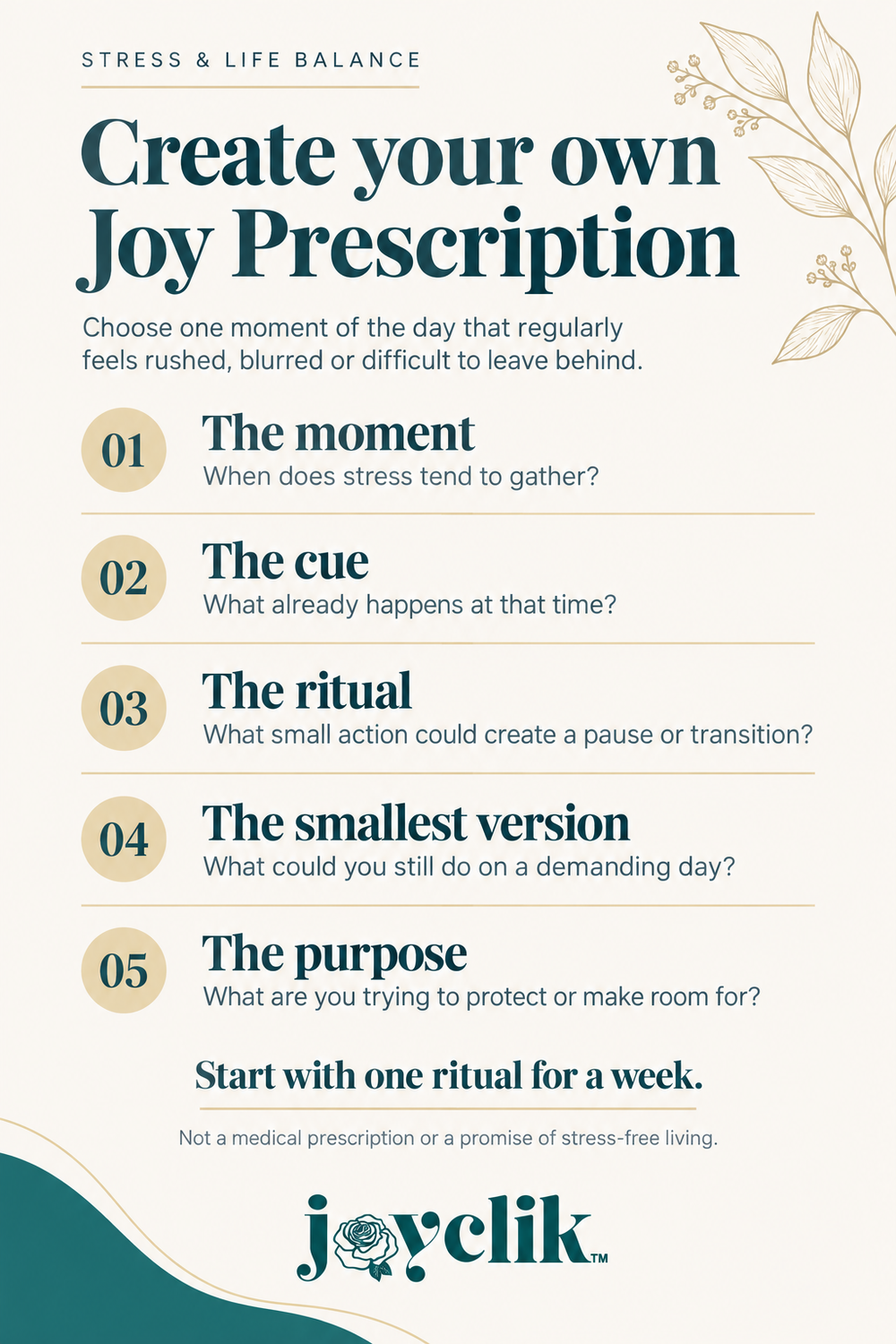
Create your own Joy Prescription
Choose one moment of the day that regularly feels rushed, blurred or difficult to leave behind. Then complete these prompts:
- The moment: When does stress tend to gather?
- The cue: What already happens at that time?
- The ritual: What small action could create a pause or transition?
- The smallest version: What could you still do on a demanding day?
- The purpose: What are you trying to protect or make room for?
For example:
When I close my laptop, I will write tomorrow’s first task, take two comfortable breaths and move away from the workspace. On a difficult day, I will write only the first task. This helps me protect the transition into home life.
Start with one ritual for a week. Notice whether it fits, what gets in the way and whether a different cue or smaller version would make it more realistic.
For a broader collection of repeatable practices, continue with Daily Stress Management Habits. The purpose is not to collect more techniques, but to choose the smallest support that genuinely fits your day.
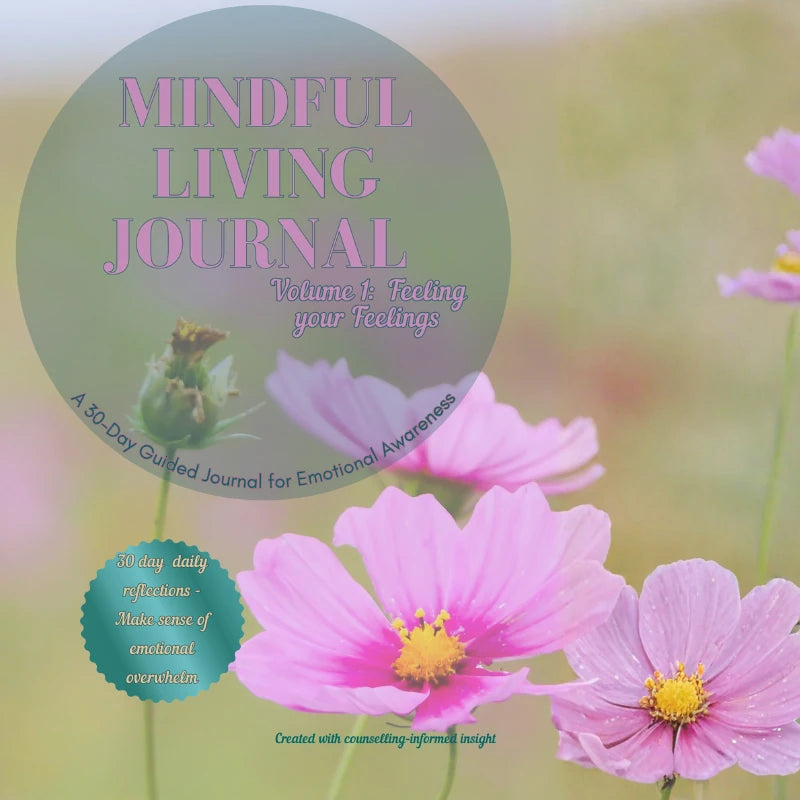
If you would like a little structure for a daily reflection ritual, our Mindful Living Journal offers guided prompts and feelings support. You can use that pause to put words to your experience and notice patterns over time, keeping the practice small enough to fit the day you are actually having.
Practical takeaways
- A useful ritual creates a small moment of intention; it does not need to eliminate stress.
- Attach the ritual to an existing cue rather than waiting for spare time.
- Define a very small version for demanding days.
- Use tracking as information, not judgement.
- Return after interruptions without treating them as failure.
A gentle responsible-use note: These practices provide general educational support and will not address every source of stress. If stress is persistent, severe, affecting your ability to function, or linked with concerns about your safety or mental health, contact an appropriately qualified health professional or a trusted local support service.
Frequently asked questions
What is a stress-relief ritual?
A stress-relief ritual is a small action performed with intention at a recognisable point in the day. It might mark the beginning of the morning, the end of work or the transition towards sleep. Its purpose is to create a pause or change of pace, not to guarantee that you feel calm.
How long should a daily ritual take?
It can take less than a minute. A ritual is more likely to remain useful when its smallest version fits a demanding day. You can allow it to take longer when time and capacity are available without making the longer version the standard you must always meet.
Can a daily ritual remove stress?
No single ritual can remove difficult workloads, financial pressure, caregiving demands, conflict or health concerns. A ritual may help you notice stress earlier, create a transition or return to one supportive action. Wider changes or individual support may still be needed.
What if breathing exercises make me uncomfortable?
You do not need to use breathing as your focus. Try noticing three things you can see, listening to a familiar sound, placing your feet on the floor, stretching gently or stepping outside briefly. Choose an approach that feels comfortable and appropriate for you.
How can I remember to use the ritual?
Attach it to something that already happens consistently, such as closing your laptop, putting the kettle on, arriving home or charging your phone. The existing action becomes the reminder, so the ritual does not depend entirely on motivation.
When should I seek professional help for stress?
Seek individual guidance when stress is persistent, severe, worsening, affecting sleep or daily functioning, or linked with concerns about your mental or physical health. If you are worried about immediate safety, contact your local emergency or crisis support service.
Keep exploring the Stress & Life Balance pathway
Topic: Mindful Daily Habits
- Stress & Life Balance Journal - practical articles for specific stress and balance questions.
- Stress & Life Balance Guide - the wider landscape of overwhelm, boundaries, recovery and sustainable life balance.
- Wellness Knowledge Hub - explore all four JoyClik™ wellbeing pillars.
The free daily-habits guide and optional JoyClik™ journal shown below continue the pathway into gentle, repeatable practice.
References and further reading
- World Health Organization. Stress: questions and answers. Updated 2026.
- Lally, P., van Jaarsveld, C. H. M., Potts, H. W. W., & Wardle, J. How are habits formed: Modelling habit formation in the real world. European Journal of Social Psychology. 2010.
- Wood, W., & Rünger, D. Psychology of Habit. Annual Review of Psychology. 2016.
- Balban, M. Y., Neri, E., Kogon, M. M., et al. Brief structured respiration practices enhance mood and reduce physiological arousal. Cell Reports Medicine. 2023.

Stress & Life Balance ArticlesBalance
How to Create More Balance in Life Without Chasing Perfection
Read article
Stress & Life Balance ArticlesMental Load & Energy
The Mental Load at Home: Why Remembering Everything Is So Exhausting - and How to Share It
Read article
Emotional Wellbeing ArticlesEmotional Regulation