
JoyClik Wellbeing BlogStress & Life Balance ArticlesBalance
How to Create More Balance in Life Without Chasing Perfection
Life balance is not an equal division of time. Explore realistic ways to protect your energy, priorities and recovery without expecting every area of life to receive equal attention.

Life balance is not an equal split of time across every part of life. It is a workable relationship between your responsibilities, needs, values and available energy. A balanced season may still be busy, but it should leave enough room for recovery, connection and the parts of life that help you feel like yourself.
When life feels stretched, the instinct is often to organise harder, become more disciplined or finally “get on top of everything”. Yet many people are not struggling because they have failed to plan well enough. They are trying to carry more than their current time, energy or circumstances can comfortably hold.
Creating more balance begins with a gentler question: What needs to change so this season becomes more sustainable?
What life balance really means
Balance is sometimes pictured as a perfectly level scale: work on one side, home on the other, with enough time left for sleep, exercise, relationships, responsibilities and self-care. Real life rarely stays that still.
Some weeks require more attention at work. A child may need extra support. Health, grief, study, finances or caring responsibilities can temporarily take up more space. Balance does not mean pretending these demands are equal. It means noticing what the current season is asking of you while protecting enough capacity to keep responding without becoming steadily depleted.
Balance is less about holding everything evenly and more about knowing what needs attention, what can wait and what helps you recover.
This makes balance responsive rather than fixed. You are not searching for one ideal routine that will work forever. You are learning how to adjust when your needs, roles or resources change.
This article focuses on the wider structure of balance: capacity, priorities, boundaries and recovery. For a different angle on this, see The Joy Prescription: Daily Stress-Relief Rituals That Fit Real Life, which explores small, repeatable pauses you can use within the rhythm you already have.
Why perfect balance keeps failing
The idea of perfect balance creates an impossible standard. It suggests that if you plan carefully enough, every area of life can receive your best energy at the same time. When that does not happen, ordinary human limits can begin to feel like personal failure.
There are several reasons this version of balance breaks down:
- Time is limited. Saying yes to one demand naturally reduces the time available for something else.
- Energy changes. The same schedule can feel manageable one week and exhausting the next.
- Some responsibilities are not optional. Caregiving, health needs and financial pressure cannot always be solved with a better planner.
- Recovery needs space. Rest is not simply whatever remains after every task has been completed.
- Values sometimes compete. You may care deeply about your work and your family, or about helping others and protecting your own wellbeing.
A more useful aim is sustainable alignment: spending your time and energy in ways that broadly reflect what matters, while making honest allowances for capacity and circumstance.
Signs your balance may need attention
Imbalance can be difficult to notice because many people continue functioning. You may still meet deadlines, care for others and keep the household moving while feeling increasingly stretched underneath.
Your current rhythm may need attention if:
- rest is repeatedly postponed until everything else is finished;
- small requests feel heavier than they usually would;
- you are physically present with people but mentally working through the next task;
- your days contain responsibility but very little restoration or enjoyment;
- you feel resentful about things you previously chose willingly;
- you move from one urgent demand to another without time to reset;
- your own needs are noticed only once they become impossible to ignore.
These signs do not prove that you are doing life incorrectly. They may simply show that your current demands and available capacity are no longer fitting together well. Signs You Need More Balance in Life can help you notice those patterns without turning them into another reason to judge yourself.
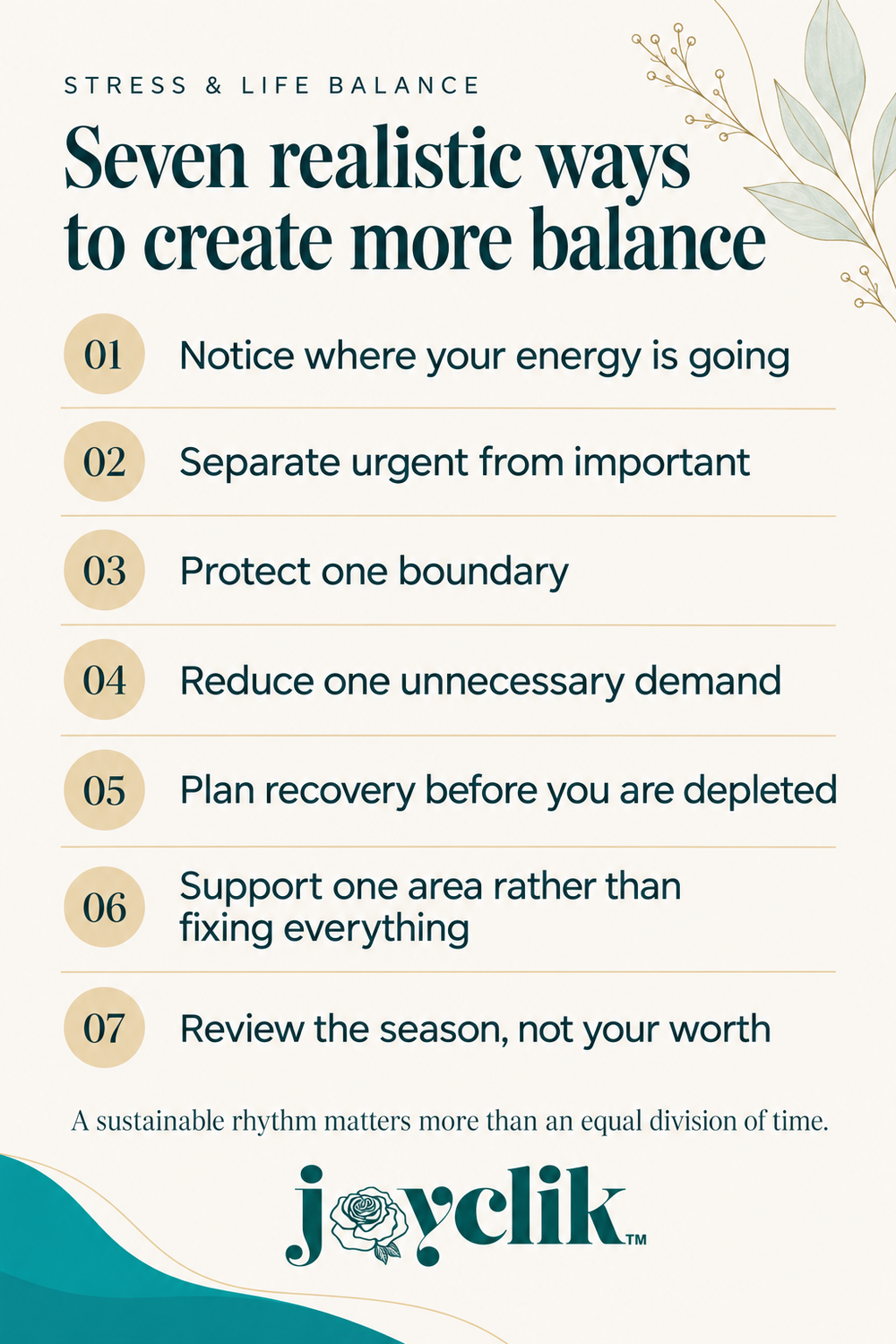
Seven realistic ways to create more balance
1. Notice where your energy is going
A calendar records time, but it does not always show emotional effort, decision-making or mental load. For a few days, notice which responsibilities leave you steady, which are tiring but meaningful, and which repeatedly drain more than they give.
You do not need to score or analyse everything. The goal is simply to see the shape of your current load more clearly.
2. Separate urgent from important
Urgency is often loud. Importance can be quieter. A notification, request or unfinished task may demand attention without being the most meaningful use of your limited energy.
Try asking:
- What genuinely needs action today?
- What matters but can be scheduled?
- What am I treating as urgent because I feel uncomfortable leaving it incomplete?
This is not about ignoring responsibilities. It is about preventing every demand from receiving the same level of urgency.
3. Protect one boundary
A boundary can be small and practical: not checking work messages during dinner, leaving one evening unscheduled, asking for notice before taking on extra tasks, or deciding that a non-essential job will wait until tomorrow.
Choose one boundary that protects something specific - sleep, family time, concentration, recovery or emotional capacity. A boundary is easier to hold when you know what it is protecting.
If work is repeatedly crossing into time needed for rest or connection, Work-Life Balance and Healthy Boundaries offers a more focused place to explore that pattern.
4. Reduce one unnecessary demand
Balance is not created only by adding better habits. Sometimes it comes from removing, postponing, sharing or simplifying something.
Consider whether one task could be:
- done less often;
- completed to a “good enough” standard;
- shared with someone else;
- moved to a quieter week; or
- released because it no longer serves the current season.
5. Plan recovery before you are depleted
Recovery does not have to mean a holiday or an uninterrupted afternoon. Research into recovery from work-related demands describes experiences such as mentally detaching, relaxing, choosing how to use some of your time and doing something that offers a sense of learning or mastery.2
In everyday life this might look like a quiet transition after work, a walk without multitasking, an absorbing hobby, music in the kitchen or ten minutes with no new input. The best form of recovery depends on what has been depleting you.
When depletion has become persistent rather than occasional, the guidance in Burnout Prevention and Recovery Support may be a more appropriate next step than simply adding another habit.
6. Support one area rather than fixing everything
When several areas feel out of balance, trying to overhaul all of them can create another layer of pressure. Choose the area where one small change may create the most breathing room.
That could be sleep, workload, household expectations, financial organisation, social support or time alone. One supported area can make other decisions easier.
7. Review the season, not your worth
Set aside a short weekly or fortnightly check-in:
- What felt especially heavy?
- What supported me?
- What needs more protection next week?
- What can be allowed to remain unfinished?
Treat this as information, not a performance review. The purpose is to adjust your rhythm - not judge yourself for having limits.
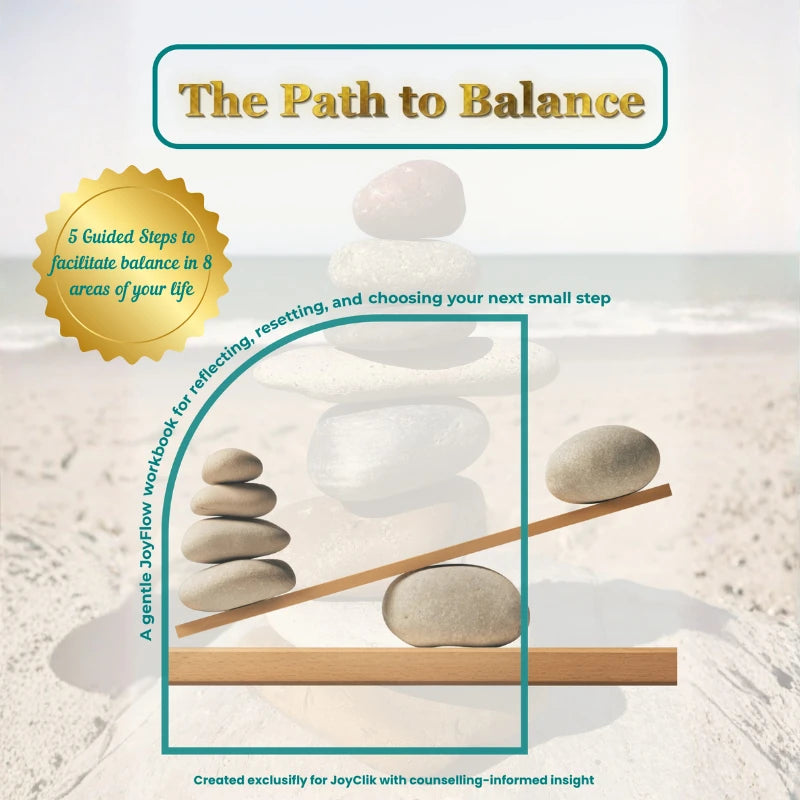
If you would like a more structured way to explore what needs attention, our The Path to Balance workbook brings together the Joyflow Wheel™ and guided reset pages. These offer a place to reflect on different areas of life, choose one manageable focus and return to your plan as your circumstances change.
What to do when life cannot be neatly balanced
There are seasons when demands cannot be reduced enough: illness, caregiving, grief, financial strain, major transitions or work circumstances may leave little flexibility. In those times, “finding balance” can sound unrealistic or even dismissive.
The aim may need to become smaller:
- protect one essential need;
- ask for one form of practical support;
- lower one non-essential expectation;
- create one brief transition between demanding roles;
- stay connected with one trusted person.
The World Health Organization’s stress guidance similarly emphasises practising manageable skills for a few minutes at a time rather than waiting for ideal circumstances.1 Small support does not remove a difficult reality, but it can help you meet that reality with slightly more space and steadiness.
Practical takeaways
- Balance is responsive; it changes as your roles, energy and circumstances change.
- A sustainable rhythm matters more than an equal division of time.
- Protect one boundary before trying to redesign your whole life.
- Recovery deserves a place in the plan rather than whatever time remains.
- Review your current season with curiosity, not self-criticism.
A gentle responsible-use note: This article offers general educational support and is not a substitute for personalised mental-health, medical, financial or workplace advice. If stress is persistent, significantly affecting daily life, or accompanied by concerns about your safety or wellbeing, contact an appropriately qualified professional or a trusted local support service.
Frequently asked questions
What does having balance in life actually mean?
Life balance means that your responsibilities, needs, values and available energy fit together in a reasonably sustainable way. It does not require every part of life to receive equal time. The balance may change as your roles, health, relationships and circumstances change.
How do I know which area of life to focus on first?
Begin with the area where one manageable change could create the most breathing room. That may be sleep, workload, household expectations, financial organisation, recovery or support from other people. You do not need to improve every area at the same time.
Can life feel balanced during a demanding season?
Sometimes the most realistic form of balance is protecting one essential need while accepting that other areas will receive less attention temporarily. During illness, grief, caregiving or financial strain, balance may mean reducing non-essential expectations and asking for practical support rather than creating an ideal routine.
What is one realistic first step towards more balance?
Choose one boundary, demand or recovery need to protect this week. Make the change specific - for example, leaving one evening unscheduled, delaying a non-essential task or taking a short transition before moving from work into home life.
How can boundaries support life balance?
A boundary protects time, energy, attention or recovery from being continually absorbed by new demands. It is easier to hold when you can name what it protects and communicate it clearly, rather than treating the boundary as a rejection of another person.
What if stress continues even after I make changes?
Small adjustments cannot resolve every source of stress. If stress remains persistent, severe, affects your daily functioning or is linked with concerns about your mental or physical health, seek individual guidance from an appropriately qualified professional.
Keep exploring the Stress & Life Balance pathway
Topic: Balance
- Stress & Life Balance Journal - practical articles for specific stress and balance questions.
- Stress & Life Balance Guide - the wider landscape of overwhelm, boundaries, recovery and sustainable life balance.
- Wellness Knowledge Hub - explore all four JoyClik™ wellbeing pillars.
The free planning guide and optional JoyClik™ resource shown below continue the pathway from reflection into one realistic, adjustable next step.
References and further reading
- World Health Organization. Doing What Matters in Times of Stress: An Illustrated Guide. 2020.
- Sonnentag, S., & Fritz, C. The Recovery Experience Questionnaire: Development and validation of a measure for assessing recuperation and unwinding from work. Journal of Occupational Health Psychology. 2007.
- Agolli, A., & Holtz, B. C. Facilitating detachment from work: A systematic review, evidence-based recommendations, and guide for future research. Journal of Occupational Health Psychology. 2023.

Stress & Life Balance ArticlesMental Load & Energy
The Mental Load at Home: Why Remembering Everything Is So Exhausting - and How to Share It
Read article
Stress & Life Balance ArticlesMindful Daily Habits
The Joy Prescription: Daily Stress-Relief Rituals That Fit Real Life
Read article
Emotional Wellbeing ArticlesEmotional Regulation